


Impact Resistant Laminated Glass: How It Works
The popular advice is simple: upgrade the pane and your home becomes hurricane-safe. That advice is incomplete, and on a custom coastal project it can be dangerously misleading. Impact resistant laminated glass is not a standalone shield. Its rating belongs to a tested assembly that includes the glass, interlayer, frame, hardware, anchorage, and installation conditions.
That distinction explains why an elegant luxury window can carry impressive laminated glass and still fail review. The glass may be sound, but a substituted frame, altered fastener pattern, oversized panel, or unapproved custom shape can change how the opening receives and transfers impact and wind pressure. A serious specification starts with the approved assembly, not the marketing name applied to the glass.
Table of Contents
- The Assembly Myth in Coastal Glazing
- From Automotive Windshields to Architectural Shields
- Interlayer Chemistry and Penetration Resistance
- Decoding Missile Impact and Pressure Testing
- Why Field Substitutions Invalidate Hurricane Ratings
- Long-Term Edge Degradation and Climate Exposure
- The Architect's Specification Checklist for Impact Systems
The Assembly Myth in Coastal Glazing
The pane is only one component
Laminated glass does an important job. When the glass plies crack, its polymer interlayer holds the fragments together and helps preserve a barrier. That post-breakage behavior is valuable for safety and security, but it doesn't, by itself, prove that a window or door can resist hurricane debris and subsequent wind loading.
ASTM E1886 evaluates windows, doors, curtain walls, and impact-protective systems through missile impacts followed by cyclic pressure differentials. ASTM E1996 provides the related performance specification for windborne debris. The test concerns the behavior of the complete opening, not a loose glass sample. The frame must retain the glazing, the anchors must transfer loads into the structure, and the installation must match the tested arrangement.
Practical rule: Specify an impact-rated assembly, not impact glass in isolation.
This matters most in custom steel and aluminum work, where the visual design often changes from opening to opening. A narrow steel frame, a deep aluminum frame, a large pivot door, and a multi-panel slider don't necessarily share the same structural behavior, even when they use a similar laminate. A product that passes in one frame depth or size may not retain that approval after a field substitution.
For homeowners comparing systems, browse impact window options for Florida homes with the same caution you'd apply to any coastal product comparison. Look for the approval documents and tested limitations, not only the phrase “impact-rated.” The practical distinction is also addressed in this overview of impact-resistant windows, where the conversation should begin with the system rather than the pane.
What the rating actually covers
A credible submittal should identify the approved glass makeup, frame profile, maximum opening, design pressure, missile category, anchorage, and installation details. If any of those elements changes, the design team needs confirmation that the revised configuration remains covered.
Luxury projects often go wrong. A contractor may propose a different frame because it is available sooner. A fabricator may adjust the mullion layout to suit a site condition. A homeowner may request a larger uninterrupted panel after approval. Each change can affect the tested performance, even if the replacement glass has the same nominal thickness.
The better mental model is straightforward: the glass provides retention and impact resistance, while the frame and its connections keep the barrier attached to the building. Hurricane performance comes from their interaction.
From Automotive Windshields to Architectural Shields
The modern laminated windshield began with a safety problem that still defines architectural impact glazing. In 1909, French chemist Édouard Bénédictus identified the laminated-glass concept and filed French patent FR405881. The basic construction placed a flexible polymer between glass plies, allowing the fractured pieces to remain attached instead of producing a fully open, shard-producing failure. The historical development is documented in the National Highway Traffic Safety Administration proceedings on laminated safety glazing.
Retention changed the failure mode
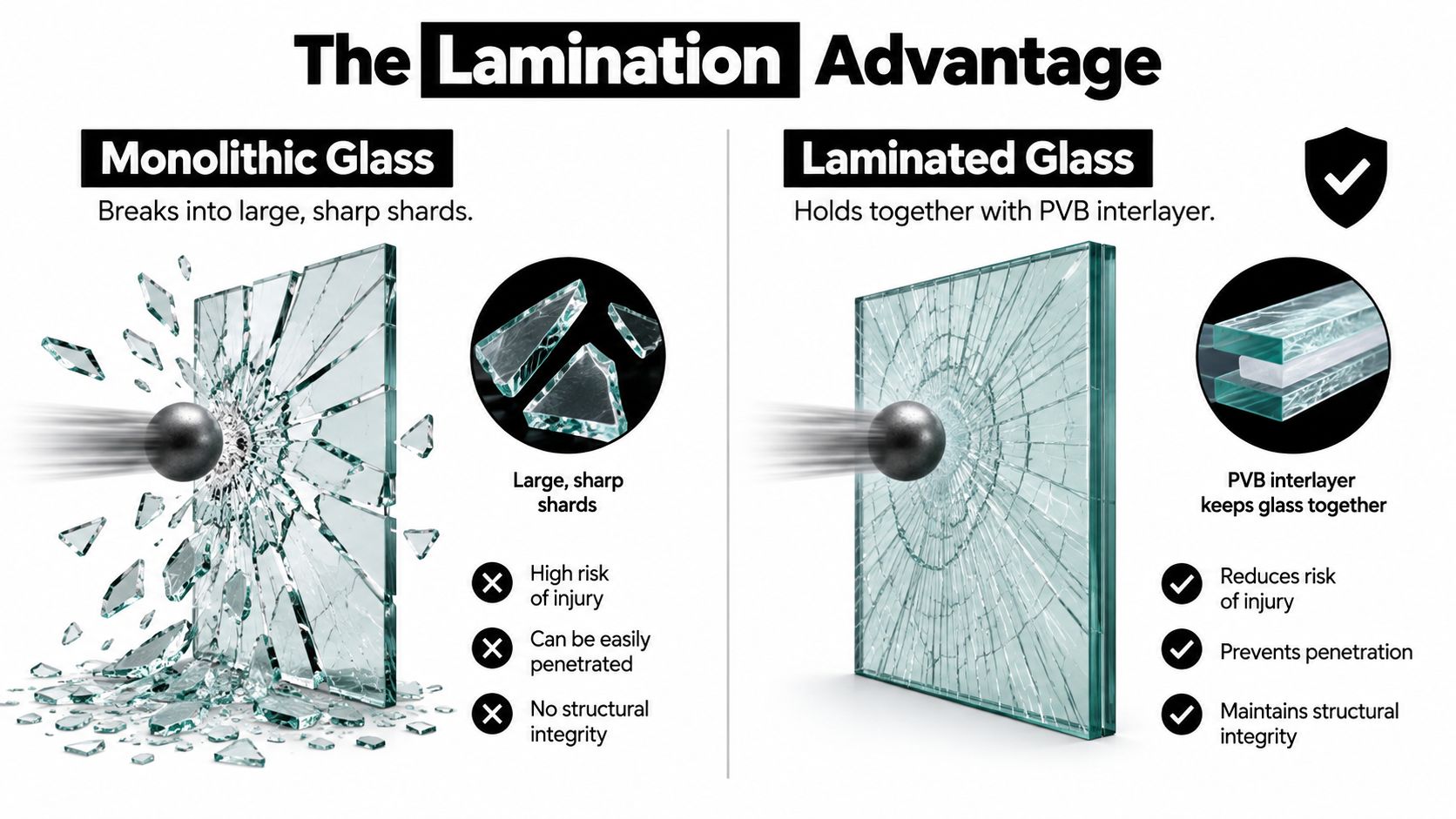
PVB, or polyvinyl butyral, was invented in 1927 by Canadian chemists Howard W. Matheson and Frederick W. Skirrow. Manufacturers later refined laminated safety glass to improve resistance to discoloration and penetration. The material's significance wasn't that it made glass harder to break. It changed what happened after breakage.
A monolithic pane can lose its barrier function as soon as it fractures. Laminated construction keeps the broken plies connected to the interlayer, so the opening may remain substantially closed even after severe cracking. That behavior reduces dangerous fallout and creates resistance that continues after the initial glass failure.
Automotive development clarified another point that remains relevant to large architectural panels. In the early 1960s, U.S. manufacturers doubled the standard PVB interlayer thickness to 0.030 inches, or 0.76 millimeters, and replaced maximum adhesion with controlled adhesion. The revised construction entered limited production in 1965 and appeared across all U.S. car lines for the 1966 model year. Industry references report that the redesigned windshield delivered more than twice the impact resistance of pre-1966 windshields and produced fewer, less extensive, and less severe facial lacerations in crashes, as described in the NHTSA reference above.
Why thickness alone doesn't tell the story
That progression is useful because it separates several variables that are often collapsed into “thicker glass.” Resistance depends on the glass plies, interlayer chemistry, interlayer thickness, adhesion, temperature, loading rate, and the surrounding frame. A thicker pane can add mass without delivering the required tested behavior if the interlayer or frame is unsuitable.
Architectural glazing magnifies the problem. A tall door or broad fixed panel must handle impact while remaining captured in its frame and transferring pressure through anchors into the surrounding construction. The automotive lesson is therefore not to copy a windshield specification. It is to recognize that laminated performance is a material-and-assembly problem, not a glass-thickness contest.
Interlayer Chemistry and Penetration Resistance
The interlayer is the working layer that most product descriptions understate. It bonds fractured glass, deforms under impact, absorbs energy, and helps maintain a barrier after the plies crack. Its behavior changes with chemistry, thickness, temperature, and loading rate, so two laminates that look similar on a schedule can behave differently under the same event.
PVB and ionoplast serve different design priorities
Conventional PVB has useful adhesion and flexible, nonlinear viscoelastic behavior. As temperature rises, it can become substantially less stiff. That flexibility may be appropriate for some assemblies, but it also affects deformation and residual load-carrying capacity.
Stiffer ionoplast systems generally provide greater residual load-carrying capacity. Comparative testing has found stronger load-carrying and deformation resistance for SentryGlas-type ionoplast or hybrid constructions than for conventional PVB in certain configurations. Experimental impact work has also reported that interlayer thickness has a dominant influence on penetration resistance in windborne-debris impacts. These findings come from the Challenging Glass Conference research paper on laminated-glass impact behavior, not from a universal product rating.
The distinction matters on large coastal doors. A flexible laminate may retain broken fragments effectively, while a stiffer construction may limit deflection and carry more residual load. Neither characteristic is automatically the deciding factor. The correct selection depends on the hazard, panel geometry, climate, design pressure, and the approval available for the complete frame.
Low-temperature testing exposes the trade-off
A low-temperature repeated-impact program at −12 °C recorded PVB failure after a subsequent 12,900 N impact. The tested ionoplast laminate survived ten additional impacts at that load and failed only during a later 17,200 N impact. Those values are reported in the cited research, and they shouldn't be converted into a blanket promise for every PVB or ionoplast product.
They do show why generic language such as “heavy-duty laminated glass” isn't enough. A specification should ask for the approved laminate build-up and the tested temperature range. It should also identify the glass ply thicknesses, interlayer type and thickness, edge exposure limits, and the frame used during qualification.
The strongest laminate on paper is irrelevant if the tested configuration doesn't match the opening you're building.
For a coastal door, I'd treat the following as decision inputs rather than optional product details:
- Hazard: Identify whether the project faces windborne debris, human impact, forced entry, or another defined threat.
- Climate: Review temperature, humidity, solar exposure, and the likelihood of sustained heat at the glazing edge.
- Geometry: Confirm the exact panel dimensions, aspect ratio, mullion pattern, and operating type.
- Approval: Match the laminate and frame to the applicable test report, product approval, and installation limitations.
A heavier or thicker laminate can look reassuring, but it isn't automatically code-compliant. The assembly still has to demonstrate the required behavior through the applicable approval.
Decoding Missile Impact and Pressure Testing
An impact label only has meaning when you know what was tested. Hurricane testing combines a debris event with wind pressure because a window that retains fragments during one strike may still fail when the storm continues to load the damaged assembly.
Large and small missiles test different hazards
ASTM E1886 exposes the complete assembly to missile impacts and then to cyclic pressure differentials. ASTM E1996 defines related windborne-debris performance requirements. In Florida procedures, a large-missile test can use a 2-by-4-inch timber, or 51 by 102 millimeters, striking the assembly at a prescribed weight and speed. Small-missile testing uses 2-gram solid steel balls traveling at 130 feet per second, approximately 89 miles per hour or 39.6 meters per second. These testing details are summarized in the technical reference on impact-glazing standards.
The sequence matters:
- Missile impact: The specified projectile strikes the specimens at defined locations and conditions.
- Penetration review: The assembly must resist penetration and limit unacceptable tears or openings.
- Pressure cycling: Positive and negative pressure cycles load the damaged assembly repeatedly.
- Configuration review: The result applies to the tested glass, frame, hardware, anchorage, specimen size, and installation arrangement.
That last step is where many specifications become vague. “Laminated glass” describes a material. ASTM E1886 and ASTM E1996 address the performance of an installed system under defined conditions.
Don't confuse safety glazing with hurricane glazing
ANSI Z97.1 safety-glazing categories address general impact performance. Historically, Category I testing used a 2.26-kilogram steel ball dropped from 1.22 meters, while Category II used a 4.88-kilogram impactor traveling at 3.66 meters per second. U.S. federal requirements under CPSC 16 CFR 1201 became law on July 6, 1977, with Category I and Category II ratings corresponding to approximately 150 and 400 foot-pounds of impact energy, respectively.
Those categories help distinguish ordinary safety glazing from hurricane-rated impact systems. They don't substitute for the windborne-debris and pressure-cycle requirements applicable to a coastal opening.
| Standard or category | Impactor type | Primary application |
|---|---|---|
| ASTM E1886 | Missile impacts followed by cyclic pressure | Complete windows, doors, curtain walls, and impact-protective systems |
| ASTM E1996 | Defined windborne-debris performance | Hurricane-related debris classification |
| ANSI Z97.1 Category I | 2.26-kilogram steel ball dropped from 1.22 meters | General light-duty safety glazing |
| ANSI Z97.1 Category II | 4.88-kilogram impactor at 3.66 meters per second | General heavy-duty safety glazing |
| CPSC 16 CFR 1201 | Category I and Category II safety levels | Federal architectural safety-glazing requirements |
Ask the manufacturer which standard applies, what missile category was used, and whether the report covers your frame and opening. A safety label is not a hurricane approval.
Why Field Substitutions Invalidate Hurricane Ratings
Most failures in coastal specifications don't begin with a bad idea about laminated glass. They begin with an “equivalent” substitution made after the approval documents are issued. The substitution may look minor on site, but the tested assembly doesn't know that it was intended to be minor.
Approval follows the tested configuration
Florida's large-missile protocol evaluates the glass, frame, anchorage, and installation together. The large missile uses a 2 × 4 timber weighing approximately 9 pounds, or 4.1 kilograms, at 50 feet per second, or 15.2 meters per second, with two impacts on each of three specimens, followed by repeated positive and negative pressure cycles. The approval depends on preventing penetration and limiting post-impact openings, as described in the Florida Building Commission staff analysis.
For openings within 30 feet, or 9.1 meters, of grade in Florida wind-borne-debris regions, large-missile compliance is generally the relevant design consideration. That doesn't mean every opening can use the same detail. The approval still governs maximum size, frame profile, glazing bite, fasteners, anchors, and substrate.
A field substitution can change the load path in several ways:
- Frame depth: A shallower profile may provide less bite or different support at the glass edge.
- Mullions: A revised mullion layout changes panel dimensions and pressure distribution.
- Hardware: Hinges, locks, rollers, and operators influence how an active panel transfers load.
- Anchorage: New fasteners or a different substrate can alter the connection to the structure.
- Glass makeup: A changed ply or interlayer can fall outside the approved laminate build-up.
Lock the details before fabrication
For a custom coastal project, the specification should name the exact product approval or test report and preserve the tested limitations in the shop drawings. This is especially important for large steel or aluminum doors, where frame, hardware, and anchorage are inseparable from the opening's performance.
A contractor should not substitute a different frame because the glass remains unchanged. The glass may be the same, but the tested assembly is not. For related design considerations, review this guide to hurricane-proof patio doors, while still requiring the project-specific approval documents from the selected manufacturer.
Long-Term Edge Degradation and Climate Exposure
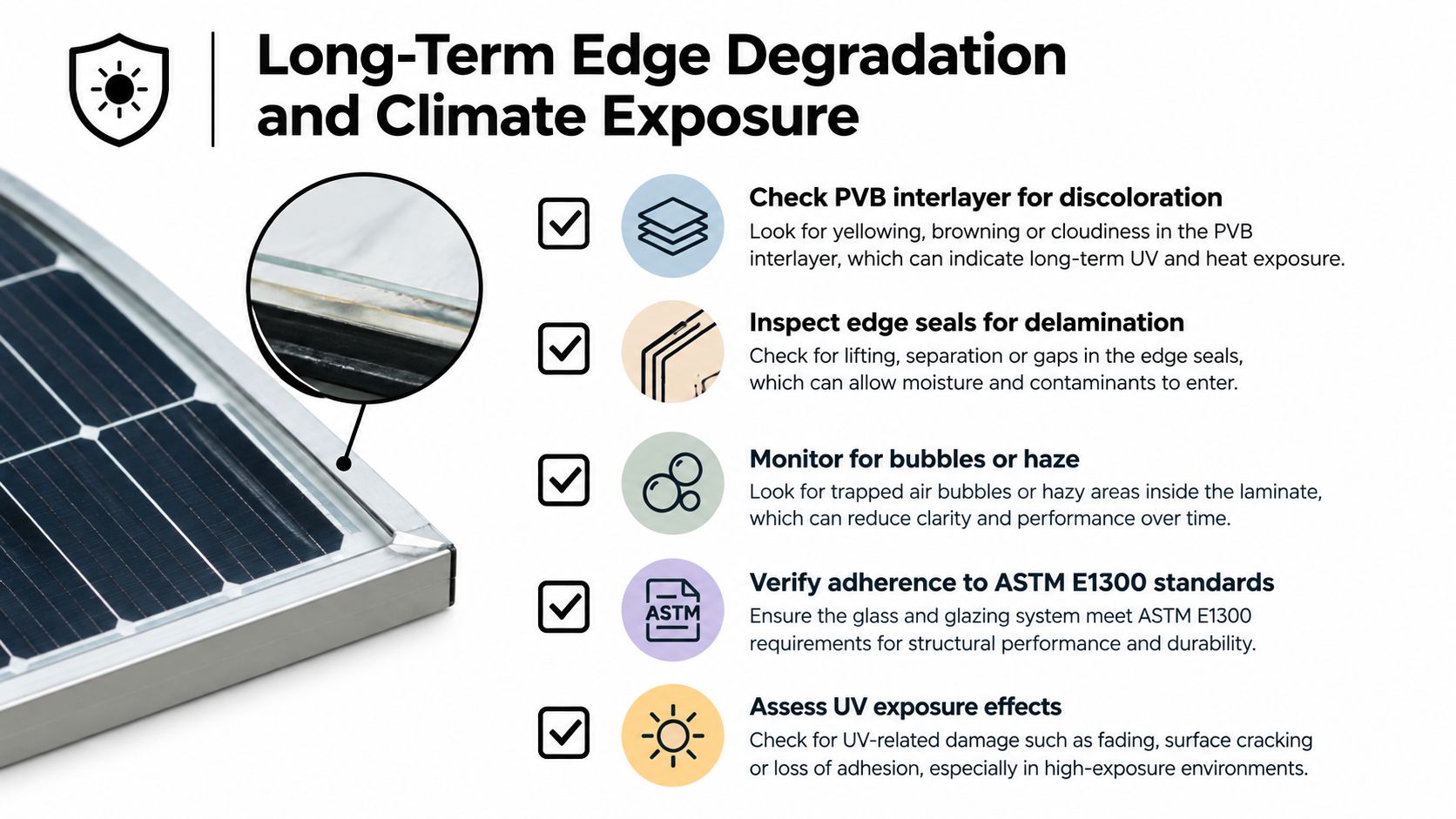
Impact resistance describes performance during a defined event. It doesn't promise immunity from aging. On coastal and tropical projects, the exposed interlayer edge may become the long-term weak point, particularly where moisture, heat, ultraviolet exposure, condensation, or failed seals reach the laminate.
Protect the edge, not just the face
Moisture entering at an exposed glass edge can reduce interlayer shear stiffness and bond strength. Research also shows that environmental aging affects polymer systems differently. EVA generally retained properties better under tested conditions, while SG-type interlayers experienced substantial bond-strength reductions after water immersion. EVA nevertheless began tearing at 60 °C, according to the study on environmental aging of laminated glazing polymers.
These findings don't establish one universally superior interlayer. Performance depends on the interlayer, temperature, humidity, ultraviolet exposure, glass size, frame design, and approval system. A laminate that performs well in one climate or edge detail may not be the right choice for a high-solar coastal door with a vulnerable glazing pocket.
Drainage and edge protection deserve the same attention as impact testing. Keep wet glazing pockets from trapping water, use sealants compatible with the interlayer and frame system, and make sure setting blocks don't create unintended moisture paths or concentrated stresses. Condensation control matters too, especially where interior humidity meets a cold frame or edge condition.
Build inspection into ownership
A coastal owner shouldn't wait for a visible failure after a storm. Periodic inspection can identify changes before they spread across the laminate.
Look for:
- Haze or whitening: These may indicate changes at the interlayer or bond line.
- Bubbles: Isolated or expanding bubbles deserve documentation and evaluation.
- Edge separation: Delamination at the perimeter can progress when moisture remains present.
- Seal failure: Failed perimeter seals can expose the edge to repeated wetting.
- Frame and drainage defects: Blocked paths or corrosion can keep the glazing pocket damp.
Visibly delaminated units should be evaluated for replacement. Cleaning the face of the glass won't correct a bond failure inside the laminate, and a product described as impact-resistant isn't permanently hurricane-safe just because it passed its original test. The approval establishes event performance when new and correctly installed. Maintenance protects the conditions that allow the assembly to keep behaving as designed.
The Architect's Specification Checklist for Impact Systems
A reliable specification gives the manufacturer enough information to prove that the proposed unit matches the project's hazard and geometry. “Impact-resistant laminated glass” is a starting description, not a complete performance requirement.
Request the evidence in writing
Ask for the following before approving shop drawings:
- Approval identification: Record the exact product approval number, test report, and applicable standard.
- Missile category: Confirm whether the opening requires large- or small-missile performance.
- Design pressure: State the required positive and negative design pressures for the opening.
- Maximum tested size: Compare the approved dimensions with the proposed panel, sash, door leaf, or multi-panel span.
- Laminate build-up: List every glass ply, interlayer type, interlayer thickness, and relevant edge limitation.
- Frame inclusion: Confirm whether the steel or aluminum frame, mullions, hardware, and glazing system are part of the approval.
- Anchorage: Identify fastener type, spacing, embedment, substrate, and installation tolerances.
- Glazing details: Include glazing bite, setting blocks, sealants, drainage, and perimeter conditions.
- Custom geometry: Obtain written confirmation for arches, angled heads, unusual corners, or other non-rectangular shapes.
- Substitution control: Require engineering review before changing glass, frame depth, hardware, panel size, anchors, or installation substrate.
Treat custom shapes as a separate approval question
A custom arch or oversized panel may be manufacturable, but that doesn't mean it carries the same hurricane rating as a standard rectangular unit. Geometry changes stress distribution, edge support, frame behavior, and often the tested size range. The manufacturer must confirm whether the exact shape and dimensions are covered by an existing approval or require a different tested configuration.
This is also where slim-frame aesthetics need disciplined coordination. A narrow profile can satisfy the design intent, but the frame still has to provide the required bite, hardware support, anchorage, and pressure resistance. For projects combining refined sightlines with decorative or structural metalwork, explore metal doors with glass while keeping the impact approval separate from the aesthetic discussion.
Black Badge Doors offers custom steel and aluminum windows and doors, including impact-rated aluminum configurations for Florida and Miami-Dade requirements. The useful question isn't whether a supplier can produce a beautiful custom unit. It's whether the proposed glass, frame, hardware, dimensions, anchorage, and installation details are documented as one approved system.
A disciplined architect or homeowner should ask for the approval package before selecting the finish, not after fabrication begins. That single decision prevents many expensive changes and keeps the design conversation tied to what the tested assembly can support.
Black Badge Doors can help develop custom steel and aluminum window and door configurations with the glass and frame details coordinated for coastal requirements. Visit Black Badge Doors to discuss your opening sizes, custom shapes, hardware, and the approval documentation needed for a compliant impact-rated assembly.
Read more
Glass Metal Doors: A Complete Specification Guide
You've found the door that makes the entire room feel finished. The sightlines are exceptionally narrow, the glass pulls daylight deep into the house, and the steel grid gives the opening an architectural presence that...
Read more
Thermally Broken Windows: How They Work and Why They Matter
On a cold morning, a beautiful steel window can look perfect and still make the room feel wrong. You stand near it, the center pane seems fine, but the perimeter throws off a cold stripe...
Read more