


Thermally Broken Windows: How They Work and Why They Matter
On a cold morning, a beautiful steel window can look perfect and still make the room feel wrong. You stand near it, the center pane seems fine, but the perimeter throws off a cold stripe that you can feel on your face, and that is usually the part nobody talked about in the showroom. Thermally broken windows exist to solve that exact problem, but the thermal break is only one piece of the assembly, not the whole story.
Table of Contents
- Why a Beautiful Window Can Still Feel Cold
- What a Thermal Break Actually Does
- Reading the Numbers That Actually Matter
- How Much Performance You Are Actually Buying
- Energy Codes and What They Require
- Where Thermally Broken Frames Quietly Fail
- Specifying Thermally Broken Windows With Confidence
Why a Beautiful Window Can Still Feel Cold
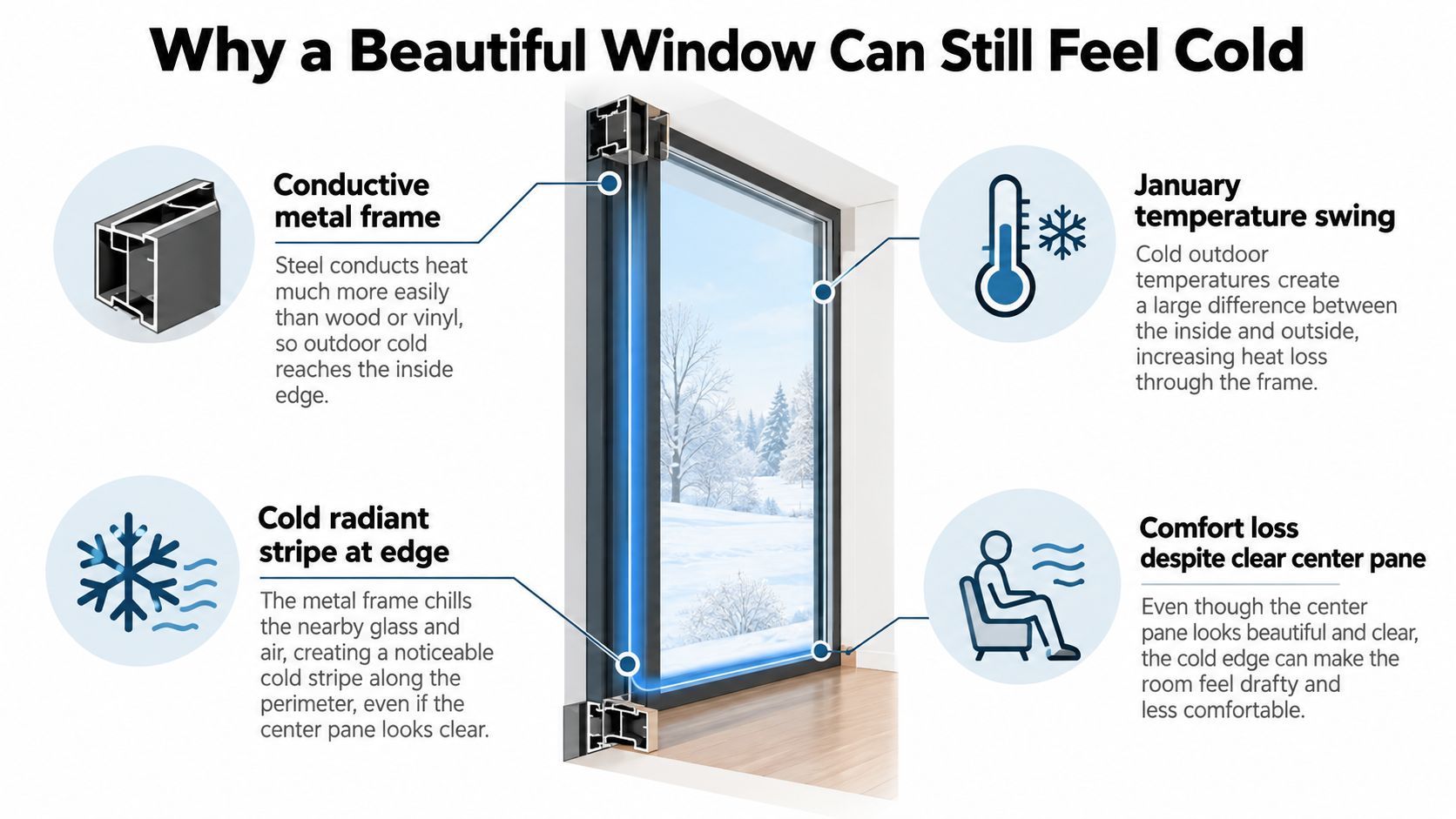
A floor-to-ceiling steel window can be visually quiet and still create a very loud comfort problem. The glass may read as “high performance” on a brochure, yet the frame edge can still pull heat away from the room and leave a perimeter that feels cold to the touch. That's why the uncomfortable part often shows up where the glass meets the metal, not in the middle of the pane.
The problem lives at the edge, not just in the glass
That cold stripe matters because people sit, stand, and sleep near the perimeter, not in the abstract center of the window. When the frame and edge-of-glass zone lose heat quickly, the room can feel drafty even when the air isn't moving much. In older language, people call that “a bad window,” but the issue is often a conductive frame path that's doing exactly what metal does.
A thermal break changes that experience by interrupting the easy path for heat to flow through the frame. For a homeowner, that means less of the uncomfortable radiant chill that makes a space feel unfinished. For an architect, it means the spec has to look beyond the center-of-glass number and ask what the whole assembly is doing at the perimeter.
Practical rule: If the room feels cold near the window but the glass itself looks fine, the frame, spacer, and junction details deserve as much attention as the glazing.
The reason this matters for thermally broken windows is simple, the break isn't decoration. It's the structural answer to a comfort and condensation problem that shows up where metal, glass, and wall meet. The more expensive the window, the more frustrating it is to discover that the perimeter was never really solved.
Black Badge Doors' residential steel windows are one example of a custom slim-frame approach that belongs in this conversation, especially when the project calls for large glass area and a thermally broken assembly. If you want to explore the broader residential context, see residential steel windows.
What a Thermal Break Actually Does
A good mental model is a metal spoon in a hot cup. The spoon carries heat straight down the handle because the material is continuous, so your hand feels the temperature change quickly. A wooden handle works differently because it interrupts that path, and that is the basic idea behind a thermal break in a window frame.
From continuous metal to interrupted flow
Inside a window, the thermal break separates the exterior metal from the interior metal with a low-conductivity barrier. That barrier can be built in different ways, including polyamide, polyurethane, or resin-based composites, but the core function is the same, interrupt the conductive path. Once the path is broken, the interior surface is less likely to get dragged down toward outdoor temperature.
The geometry matters as much as the material. A pour-and-debridge style frame and a strut-based frame don't behave identically, because the break's surface area, continuity, and placement change how heat moves through the profile. Two frames can both be called “thermally broken,” but if one has a tiny barrier and the other has a more substantial insulating separation, they won't perform the same way in use.
Why steel and aluminum don't behave the same
Steel and aluminum frames respond differently because the base metal, profile shape, and structural strategy are different from the start. A thermal break in a steel system is not just a copy-paste of an aluminum detail, because the frame geometry and sightline goals are usually different. That's also why asking for the label “thermally broken” isn't enough, you need to know how the break is built and how it was tested.
A thermal break is only useful if the rest of the frame lets it do its job.
That's the part marketing often skips. The break can reduce heat flow through the frame, but it doesn't erase the effects of spacer choice, glazing build-up, or the way the sash meets the jamb. If the assembly is designed well, the room-side metal stays closer to room temperature, and the window feels far less punitive in cold weather.
Reading the Numbers That Actually Matter
A label only helps if you know what each field means. U-factor tells you how much heat passes through the whole window, and lower is better. SHGC tells you how much solar heat the glass admits, which matters differently in cold and mixed climates. Condensation Resistance, or CR, helps show how warm the interior surface stays when conditions turn difficult.
Same U-factor, different comfort
Two windows can share a similar whole-window U-factor and still behave differently at the perimeter. That's because a low number doesn't automatically mean the frame edge will stay warm enough to avoid condensation, especially if the center of the glass is doing most of the work. The window can look “efficient” on paper and still struggle at the exact spots where moisture starts forming.
| Assembly | Whole-Window U-Factor | Frame Thermal Break | Spacer Type | Condensation Resistance |
|---|---|---|---|---|
| Assembly A | Similar whole-window rating | Thermally broken frame | Warm-edge spacer | Better perimeter performance |
| Assembly B | Similar whole-window rating | Minimal or no meaningful break | Less favorable spacer | Weaker perimeter performance |
That table is the lesson, not the exact rating. A whole-window figure tells you the average, but condensation is a surface-temperature problem at the edge, not an average problem. That's why CR and spacer choice belong in the conversation with U-factor, not after it.
For a deeper comparison of glazing choices, see double vs triple glazing. A stronger insulating unit can help, but it still needs the frame and edge details to support it.
What to ask for, not just what to ask
Ask for the NFRC-certified whole-unit rating, not a glass-only figure. Ask for the SHGC and CR for the exact configuration, because size and opening type can change the result. Then ask how the manufacturer handles the edge condition, since that's where comfort and condensation often separate.
How Much Performance You Are Actually Buying
The market talk around premium windows often blurs a basic point, you're not buying a material name, you're buying a tested thermal strategy. Lawrence Berkeley National Laboratory reports that traditional thermal-break frames provide roughly 40% to 90% improvement over traditional aluminum in modeled NFRC-size fixed windows, while highly insulating frames provide an additional 20% to 90% improvement over traditional thermal breaks. The reported highly insulating range reaches roughly 80% to 170% improvement over traditional aluminum. LBNL high-performance windows
Comparing the tiers without the hype
Those ranges don't promise a specific product result. They do show that “thermally broken” is a category, not a finish line. A thoughtfully designed system can sit much closer to the top of its class than a flashy frame with weak geometry, weak spacer strategy, or a poor tested size.
LBNL also identifies frame systems with U-factors as low as 0.6 to 0.8 W/(m²·K), while a conventional thermal-break frame is described at approximately 0.5 Btu/(h·ft²·°F), about R-2 in U.S. units. Those are useful benchmarks, but they're not a substitute for NFRC-rated whole-window data. Frame-only properties don't capture glass, mullions, operable hardware, or installation effects, and that's where many real projects drift away from the brochure number.
What that means for a buyer
A luxury steel window with a traditional thermal break isn't automatically equivalent to a high-end aluminum system. A mid-range frame that was engineered around the full assembly can outperform a premium-looking unit that only has the right vocabulary. That's why the better question is never “Is it thermally broken?” It's “How was the whole unit tested, and what configuration was rated?”
If your building team is also tightening the rest of the envelope, resource selection matters beyond windows. A practical HVAC companion resource, HVAC duct cleaning for efficiency, is useful because the best window spec still loses value if the mechanical side is wasting energy elsewhere.
Energy Codes and What They Require
The modern window rating system didn't appear by accident. Before the National Fenestration Rating Council was established in 1989, manufacturers and testing organizations often used different procedures, and reported U-factors could vary by as much as 100% when some reports described only the center of the glass instead of the complete window. NFRC adopted its initial residential U-factor procedure, NFRC 100-91, in 1991, and began producing certified U-factor ratings that year. NFRC history
Why the label became the language
That history matters because it explains why architects now lean on whole-window data. In 1992, the U.S. Energy Policy Act formally recognized NFRC and called for a voluntary national energy-rating system, and the ENERGY STAR window program launched in 1997 and required NFRC labeling for participating products. Those milestones created the framework used today to compare complete window assemblies instead of isolated materials.
For a project team, that means code compliance is never just a product marketing claim. It depends on the project's climate zone, the wall assembly, and the certification path being used. A window that works in one region may need a different SHGC or U-factor strategy in another.
What to pull before you spec
Start with the project zip code, then identify the IECC climate zone and the applicable ENERGY STAR climate zone. After that, require NFRC-certified whole-unit ratings from the manufacturer. If the quote only gives you glass performance or a generic “thermally broken” statement, it's not enough information to write a reliable spec.
Practical rule: A code-compliant window is a rated assembly in a known climate, not a marketing phrase attached to a frame extrusion.
That is the cleanest way to think about energy codes for thermally broken windows. The label is not decoration, it's the shared language that lets the design team, the code official, and the supplier talk about the same tested product.
Where Thermally Broken Frames Quietly Fail
The frame isn't always where the biggest loss happens. The window-to-wall junction, the rough opening, the sill pan, the fasteners, the flashing, and the insulation continuity can all create thermal bridges that the window rating alone doesn't capture. A 2024 review estimates that thermal bridges can increase building energy consumption by 5% to 30%, while careful installation detailing can reduce linear thermal transmittance by as much as 80%. ORNL thermal bridging paper
The opening can undo the frame
Recent modeling found that placing windows within the insulation layer reduced a junction ψ-value from 0.27 W/(m·K) to 0.02 W/(m·K), with optimized frame overlap and extenders reaching 0.005 W/(m·K). That's a huge reminder that a carefully made frame can still lose much of its advantage if the rough opening behaves like a gap in the thermal envelope. The installation details decide whether the break is part of a continuous system or a lone good idea surrounded by weak links.
Condensation risk follows the same logic. Surface temperature at the frame-to-wall edge matters, and the problem isn't solved by a low center-of-glass number alone. One study found that frame overlap of at least 20 mm raised internal surface temperatures above 13°C in its tested configurations, which reduced condensation and mold risk.
Why insulation alone can create a new problem
Adding insulation to a frame that isn't hygrothermally coordinated with the rest of the wall can backfire. A 2022 experimental study found that adding an insulation barrier to frame assemblies could reduce modeled heat leakage by roughly 90%, but it also warned that combining insulation interventions with old, non-energy-efficient frames can create vapor condensation. That's the hard truth many sales conversations skip.
For a builder, the checklist has to include the rough opening, sill pan, exterior insulation, anchors, perimeter air seal, and the indoor air and vapor control layers. For a homeowner, that means a beautiful window can still fail if the install crew treats the wall like a generic hole instead of a designed thermal junction.
If you want a clear homeowner-oriented explanation of air sealing principles, the Covenant Aire Solutions guide is a useful complement because the same sealing discipline applies around windows, just in a more concentrated zone.
Specifying Thermally Broken Windows With Confidence
A strong spec starts with the exact unit, not the category name. Require NFRC-certified whole-window U-factor, SHGC, air leakage, and CR for the exact size and configuration you're ordering. Then match the glazing package to the climate, pair it with a warm-edge spacer, and make sure the frame strategy fits the project's temperature and moisture profile.
A practical spec checklist
- Whole-unit ratings: Ask for the exact NFRC label data for the custom size, not a representative catalog example.
- Glazing strategy: Use double or triple glazing based on climate and target performance, not on marketing language.
- Frame continuity: Confirm that the frame is thermally interrupted, not merely described that way.
- Edge details: Require the spacer type, because the perimeter often decides condensation behavior.
- Installation junction: Define rough opening dimensions, insulation alignment, sill pan, and perimeter air sealing in the drawings.
- Condensation review: Request a project-specific analysis at the frame-to-wall connection, especially on large steel sightlines or multi-panel assemblies.
That approach is especially important for custom metal units like metal doors with glass, because the same perimeter logic applies when you combine slim profiles with large glazed areas. A frame can be thermally broken and still need careful coordination with the wall system around it.
What to keep an eye on next
Emerging options like vacuum glazing and aerogel-filled frame cavities are promising, and review literature points to very low lab values, including reported U-values as low as 0.2 W/(m²·K) for vacuum glazing and thermal permeability reductions of 45% for aerogel-filled frame cavities. Those figures are interesting, but they aren't interchangeable with whole-window ratings, and they're not universally available products. Treat them as future-facing tools, not shortcuts.
The right questions usually matter more than the brand name on the quote. If you want thermally broken windows that look sharp and perform the way they should, start with the rating label, then demand the junction details that make the label true in the field.
Black Badge Doors designs custom steel and aluminum window systems with thermally broken assemblies, slim sightlines, and made-to-order sizing for residential projects. If you're comparing window options for a cold or mixed-climate build, visit Black Badge Doors to review what's possible and ask for a configuration that matches the way your wall is built.
Read more

Impact Resistant Laminated Glass: How It Works
The popular advice is simple: upgrade the pane and your home becomes hurricane-safe. That advice is incomplete, and on a custom coastal project it can be dangerously misleading. Impact resistant laminated glass is not a...
Read more
Metal and Glass Doors: A Complete Buyer’s Guide
You're standing in a half-finished opening with a large drawing in your hand. The architect wants narrow sightlines, more daylight, and a door that feels integrated with the wall. The builder is asking about weight,...
Read more