


Double vs Triple Glazing: A Practical Decision Guide
Most advice on double vs triple glazing starts with a simple rule: three panes must be better than two. That rule is easy to remember and often wrong. A well-specified double-glazed unit in a thermally broken frame can be a smarter choice than a poorly configured triple unit, especially when the project sits in a warm climate, depends on daylight, or uses large operable panels.
The pane count is only one part of the assembly. Frame design, low-emissivity coatings, gas fill, spacer quality, orientation, shading, visible transmittance, and installation determine whether the extra pane earns its cost. For custom steel and aluminum work, the frame can also determine whether the glass performs as promised or loses much of its advantage at the perimeter.
This guide takes a clear position. Triple glazing earns serious consideration in cold climates, on exposed façades, and where interior surface temperature or peak heating demand matters. In many mixed and cooling-dominated U.S. projects, a high-performance double unit paired with the right thermally broken frame is the more rational specification.
Table of Contents
- Why Pane Count Is the Wrong Place to Start
- What Double and Triple Glazing Actually Are
- Thermal Performance Compared Across the Whole Window
- Sound, Comfort, and Condensation Beyond the Numbers
- Cost, Carbon, and Weight Trade-Offs in Real Projects
- Matching Glazing to Climate and Façade Orientation
- Choosing Between Double and Triple for Custom Steel and Aluminum
- Frequently Asked Questions on Double vs Triple Glazing
Why Pane Count Is the Wrong Place to Start
Counting panes is a poor way to choose a window. It's like choosing a car by counting cylinders while ignoring the transmission, weight, aerodynamics, and how you'll drive it. The number of glass layers tells you what the unit contains, not how the complete opening will perform.
Start with the certified whole-window U-factor, not the center-of-glass value. Whole-window ratings include the frame, edge, and center-of-glass effects, which matters greatly in narrow steel assemblies. A third pane can reduce heat transfer through the glass while an unbroken metal path at the frame continues to conduct heat around it. The result may look impressive on a glass schedule and deliver a much less impressive opening in the wall.
The same principle applies to solar performance. A large south- or west-facing opening may need a different low-E and solar heat-gain strategy from a shaded north-facing window. Visible transmittance also matters when the design depends on daylight. The darkest or most heavily coated triple unit isn't automatically the best choice for a room that needs winter sun or clear views.
Practical rule: Specify the frame and glass as one thermal assembly. Never approve a triple-glazed unit from a glass-only value.
A premium double with argon, a low-E coating, and a warm-edge spacer can outperform a basic triple that lacks the same attention to coatings, cavities, and edge control. The difference becomes even more important with slim steel or aluminum profiles, where the frame represents a meaningful share of the opening.
For homeowners and architects comparing custom systems, the broader principles behind custom-made windows and doors are relevant here. Made-to-order work allows the glass build-up, frame depth, hardware, and opening size to be evaluated together instead of treating the glazing as an interchangeable upgrade.
The climate verdict is straightforward. Triple glazing is most defensible in cold conditions and on highly exposed elevations. High-performance double glazing is usually the stronger value in cooling-dominated regions and many mixed-climate applications.
What Double and Triple Glazing Actually Are
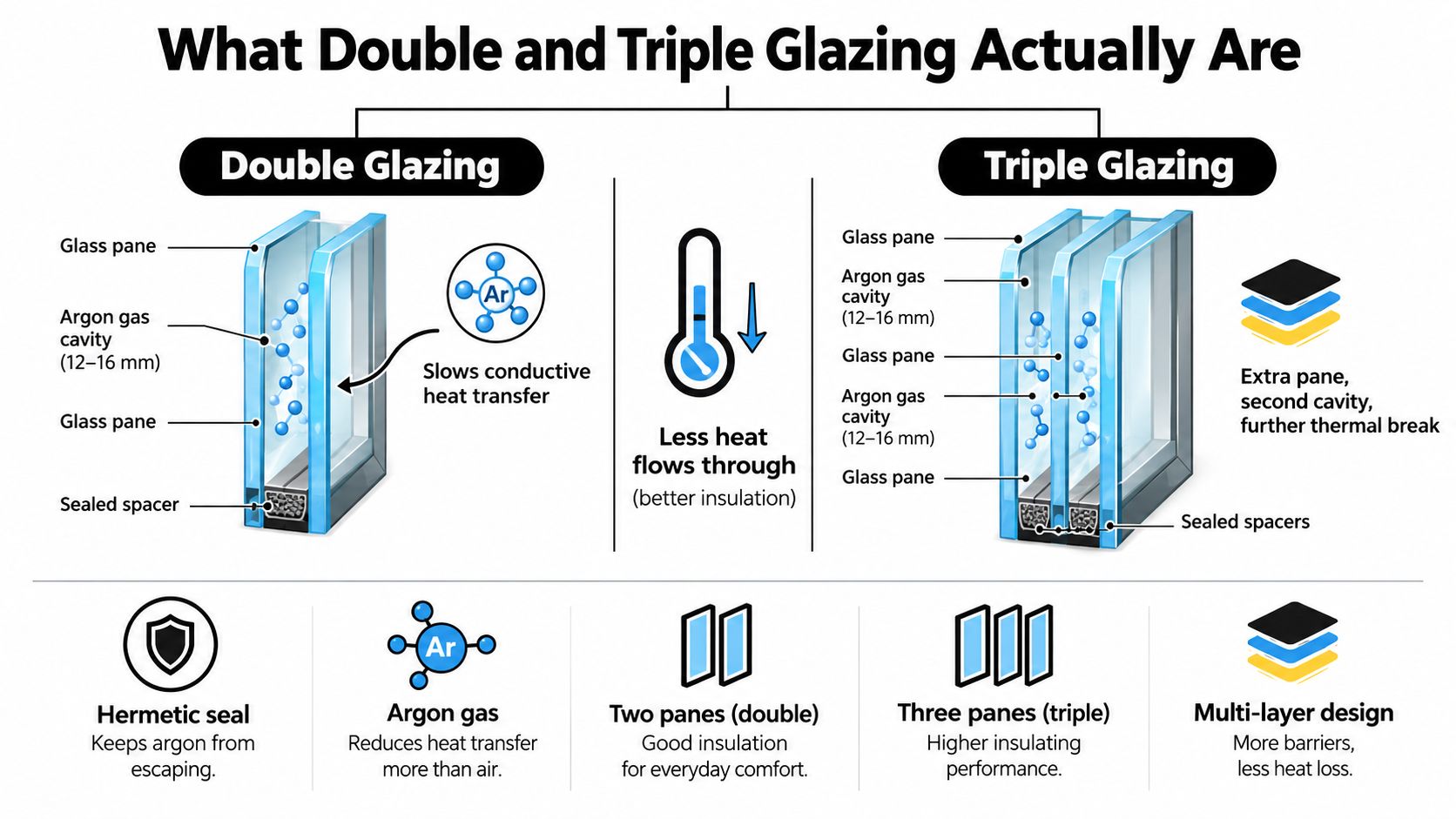
Double glazing uses two glass panes separated by a sealed cavity. Triple glazing adds a third pane and a second sealed cavity. The extra cavity creates another insulating layer, but the result depends on what fills those cavities and how the unit is built into the frame.
Premium insulating glass commonly uses argon, a low-conductivity gas that slows heat transfer through the cavity. Low-emissivity coatings control radiant heat movement by reflecting energy toward the warmer side of the assembly. A warm-edge spacer reduces heat flow at the perimeter, while the sealed edge system protects the cavity from moisture and helps preserve its intended gas-filled condition.
The parts that determine the result
A basic double unit may use one low-E coating and an argon cavity. A more demanding triple build-up may use two low-E coatings, carefully selected cavity widths, and a gas strategy chosen around the unit's thickness and target performance. The third pane is valuable because it creates another opportunity to control conductive and radiant heat transfer, not because pane count has an independent performance value.
The glass build-up also affects other design objectives. Additional layers can change visible transmittance, solar heat gain, acoustic behavior, thickness, and weight. Those changes may be desirable in one room and counterproductive in another.
The frame must accept the unit without compromising seals or operation. A deep insulating glass unit may require a different glazing pocket, gasket arrangement, bead, sash, or hardware package. On a fixed picture window, the extra thickness may be relatively simple to accommodate. On a large operable door or casement, it becomes an engineering question.
Read the specification, not the label
Ask for the complete configuration before comparing quotes. The request should identify the glass thicknesses, low-E surfaces, cavity gas, spacer, whole-unit U-factor, solar heat-gain coefficient, visible transmittance, acoustic rating when relevant, and the frame system used for the test.
“Triple glazed” is a category, not a performance specification. Two triple units can produce very different comfort, daylight, and solar-control outcomes. The same is true for double glazing, which can range from a basic unit to a highly tuned assembly designed for a specific orientation and climate.
Thermal Performance Compared Across the Whole Window
The most useful thermal metric for comparing assemblies is the whole-window U-factor. Lower is better for limiting heat transfer, but the rating only helps when you know whether it covers the complete tested unit or the glass center alone.
Representative best-in-class double-glazed units can reach approximately U-0.27, while triple-glazed units can reach approximately U-0.17, according to guidance on window and glass ratings. Those values illustrate the potential of an additional pane, not a guaranteed result for every custom opening.
Clear glass performs substantially worse than coated, gas-filled assemblies. Approximate clear double and triple values are U-0.50 and U-0.33, respectively, which is why a pane-count comparison without a coating and gas-fill comparison tells you very little. The source also emphasizes that NFRC U-factor ratings include the frame, edge, and center-of-glass effects.
A practical comparison
| Metric | Premium Double, argon, one low-E | Premium Triple, argon, two low-E | Frame-adjusted Triple in Slim Steel |
|---|---|---|---|
| Thermal direction | Strong performance when properly specified | Lower potential heat transfer through the glazing | Depends heavily on thermal breaks and frame proportion |
| Whole-unit U-factor | Can be highly competitive | Can reach a lower value than premium double | Must be confirmed from the certified complete unit |
| Solar heat gain | Tunable to orientation and climate | May reduce solar gain more, depending on coatings | Determined by glass and frame together |
| Visible transmittance | Often preserves more daylight | Can be lower because of the additional pane and coatings | Depends on glass selection and sightline ratio |
| Frame effect | Important, especially in narrow metal profiles | Can erase part of the glass advantage if poorly handled | Critical, because an unbroken metal path can conduct around the unit |
| Best use | Many mixed and warm applications, large operable openings | Cold, exposed, comfort-focused applications | Only when the thermal break, pocket, and whole-unit rating support it |
The table shows why “triple” isn't a sufficient specification. A triple unit inside a frame with weak thermal separation can lose much of its theoretical advantage. In a slim steel design, the frame-to-glass ratio may be favorable because the profile is narrow, but that makes the quality of the thermal break and edge detail even more important.
Solar gain and daylight still count
U-factor doesn't answer every façade question. A south-facing opening may benefit from controlled winter solar gain, while a west-facing opening may need strong solar control. Shading, orientation, visible transmittance, and solar heat-gain coefficient must be reviewed together, particularly for large glazed walls and doors.
If you're assessing cooling loads rather than only winter heat loss, an estimate home cooling savings can help frame the HVAC side of the decision. Treat any calculator as a planning aid, not as a promise tied to one window configuration. Actual results depend on the building envelope, equipment, operating patterns, and solar exposure.
For custom steel work, the glazing choice should sit beside the frame specification. A metal door with glass needs the same whole-assembly scrutiny as a window, with added attention to hinges, seals, thresholds, and the size and frequency of operation.
Sound, Comfort, and Condensation Beyond the Numbers
Triple glazing can improve acoustic performance, but it isn't a noise-control shortcut. The number of panes matters less than the complete acoustic build-up, including pane thickness, asymmetry, laminated interlayers, cavity widths, seals, frame leakage, and the surrounding wall.
A peer-reviewed study reported typical sound-insulation values of about 32 dB for double glazing and 38 dB for triple glazing, while reporting glass U-values of approximately 1.2 and 0.8 W/m²K, respectively. The study is useful because it shows a typical advantage for triple glazing without proving that every triple unit will outperform every double unit. Its results are available in the peer-reviewed glazing study.
Noise requires the right weak-point diagnosis
Traffic noise, aircraft noise, and voices don't enter only through the center of the glass. Sound can travel through an operable sash, perimeter seals, a trickle vent, the wall, or a poorly sealed installation joint. If the surrounding wall is the weak point, upgrading the glass alone may produce little audible improvement.
For a noise-sensitive project, ask for a whole-unit acoustic rating and identify the sound source before selecting the glass. A double unit with asymmetric panes or laminated glass may be more effective than a triple unit made from three similar monolithic panes. The goal is to disrupt the specific sound path, not to add layers by default.
Comfort is where triple often feels different
A better thermal assembly can create a warmer interior glass surface in winter. That improves the sensation near a large window and reduces the cold-radiation effect that makes occupants move away from the opening. It can also help a design use more glazing without making the perimeter feel as cold, provided the frame and edge detail perform with the glass.
Condensation is more specific than many sales claims suggest. Interior condensation depends on indoor humidity and the temperature of the interior surface. A better unit can raise that surface temperature, but it can't compensate indefinitely for excessive humidity, poor air circulation, or a thermally weak frame.
Condensation between panes indicates a failure of the insulating-glass seal, not normal winter behavior. That condition should be handled through the unit warranty and replacement process. Ask the manufacturer how the warranty treats seal failure, coatings, gas-filled units, custom shapes, and operable assemblies before placing the order.
The practical question is simple: Are you buying triple glazing for noise, surface temperature, peak-load reduction, or condensation resistance? Each goal may require a different glass and frame specification.
Cost, Carbon, and Weight Trade-Offs in Real Projects
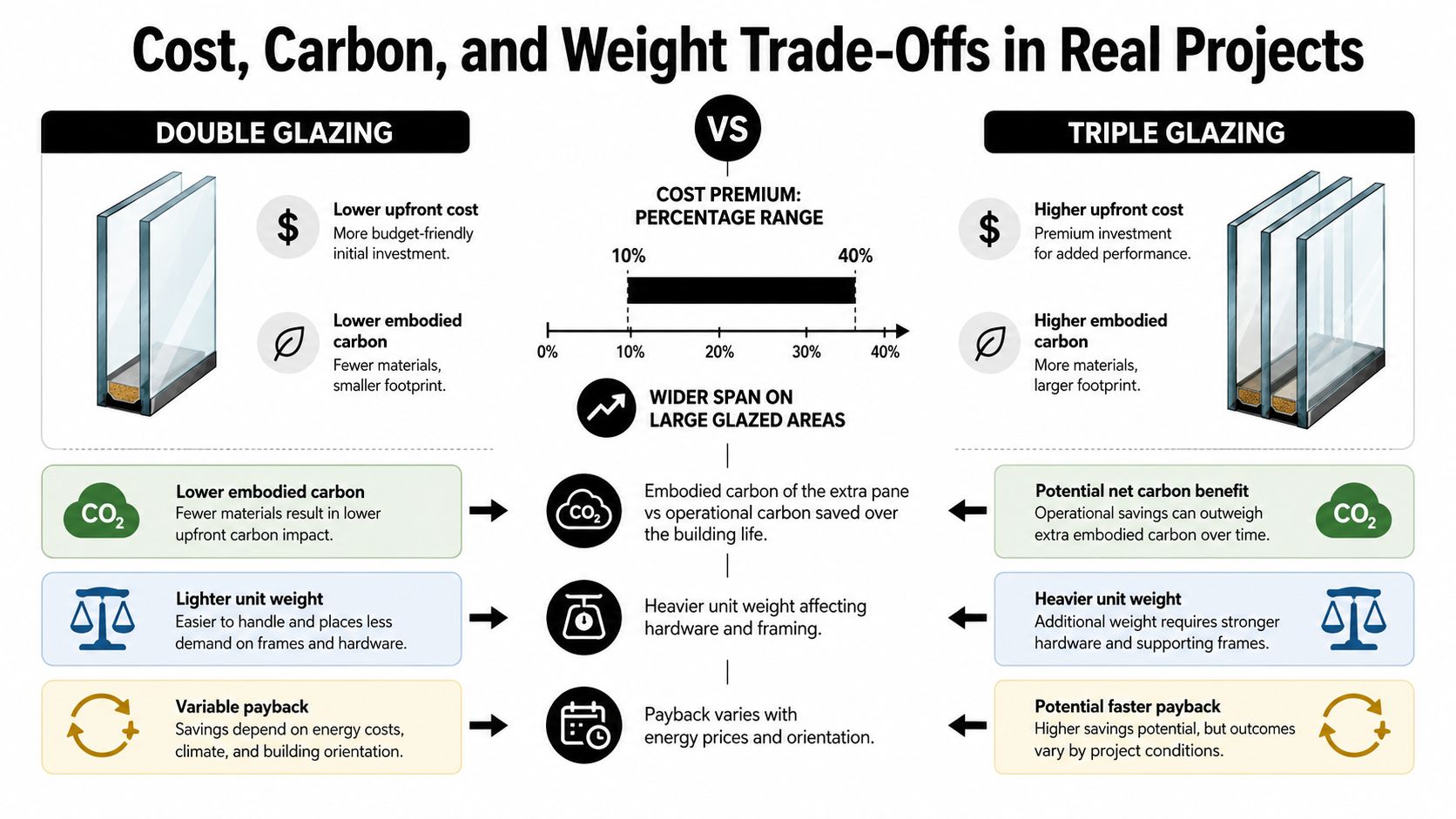
Triple glazing adds material and complexity. The extra pane increases the unit's embodied impact, the insulated glass unit becomes heavier, and the frame may need a deeper pocket or stronger operating hardware. The project cost also varies with glass type, custom dimensions, coatings, edge systems, fabrication volume, and installation conditions, so a universal surcharge isn't a reliable planning figure.
The carbon question deserves equal attention. One lifecycle assessment estimated embodied emissions of 113.3 kgCO2e/m² for double glazing and 140.4 kgCO2e/m² for triple glazing, as summarized by Historic England's construction-material guidance. The extra glass and associated frame requirements create an upfront disadvantage that operational energy savings may or may not recover.
Where triple earns its material cost
The same lifecycle assessment estimated energy savings of 23.1 MWh in northern climates, 15.1 MWh in central climates, and 8.8 MWh in southern climates over 30 years. It found that triple glazing generally repaid its embodied-carbon disadvantage in northern and central European climates, but not necessarily in southern climates.
Those figures aren't a U.S. project guarantee. They demonstrate the direction of the decision: cold conditions create more opportunity for the third pane to offset its added material, while warm conditions may not. Local electricity carbon intensity, heating fuel, HVAC efficiency, glazing area, shading, and service life can change the result.
Weight affects daily operation
A heavier unit changes more than the shipping plan. On a large operable door, it affects hinge loads, latch alignment, operator selection, sash deflection, and the effort required to open and close the panel. Hardware that works comfortably with a double unit may need a different capacity or adjustment strategy with triple glazing.
The risk is highest when the design pushes both size and slimness. A narrow frame can preserve the intended appearance, but the hardware and reinforcement still need to carry the actual panel. Fixed windows are more forgiving. Frequently operated doors, outswing casements, and tall pivot panels demand a detailed review.
Triple glazing can also reduce daylight or solar gain when its coatings are selected primarily for insulation. That may be exactly right for a north-facing opening in a cold region. It may be the wrong compromise for a shaded living room that relies on passive light or a south-facing space designed around winter sun.
Matching Glazing to Climate and Façade Orientation
Climate should lead the decision, but orientation decides how strongly the recommendation applies. A cold-climate north elevation and a sun-exposed south elevation in the same house don't have identical glazing priorities.
Cold-climate projects
Triple glazing is most compelling where winter heat loss and interior surface temperature dominate. Lawrence Berkeley National Laboratory estimated that thin triple glazing replacing typical low-E double glazing could reduce total residential energy use by about 16% in Minneapolis, 12% in Washington, D.C., and 7% in Houston, as reported in its analysis of thin-triple thermal performance.
Use those locations as climate benchmarks, not as guaranteed savings for a particular home. In cold regions, specify a thermally broken steel or aluminum frame, a warm-edge spacer, low-E coatings selected for the façade, and a certified whole-unit rating at the actual custom size. Triple is especially defensible on exposed elevations, large openings, and rooms where cold interior edges would be noticeable.
North-facing glazing usually favors heat-loss reduction because it receives less useful direct solar gain. South-facing glass requires more careful solar analysis. A highly insulated triple unit can still be the wrong choice if its coating blocks valuable winter sun or leaves the room too dark.
Mixed-climate projects
Mixed climates call for a more selective approach. A high-performance double unit with low-E coating, argon, a warm-edge spacer, and a thermally broken frame often provides the right balance for ordinary residential openings. Reserve triple for large exposed façades, rooms with persistent winter comfort complaints, or designs where peak heating reduction justifies added weight and complexity.
East and west elevations deserve special scrutiny because morning and afternoon solar exposure can create cooling problems even when winter performance matters. Choose the solar heat-gain coefficient around orientation and shading rather than assuming that the lower value is always better.
Cooling-dominated projects
In cooling-dominated regions, start with solar control, shading, airtightness, and frame performance. A premium double-glazed unit may be preferable when it preserves more daylight, manages solar gain effectively, and reduces panel weight on operable openings.
That doesn't make triple useless in warm climates. The peer-reviewed study cited earlier found meaningful heat-loss and heat-gain reductions in a warm-climate model, but it also found lower solar heat gain with triple glazing. That outcome can help a west-facing room, yet hurt a space that benefits from controlled winter sun. Select the assembly by façade, not by a national slogan.
Choosing Between Double and Triple for Custom Steel and Aluminum
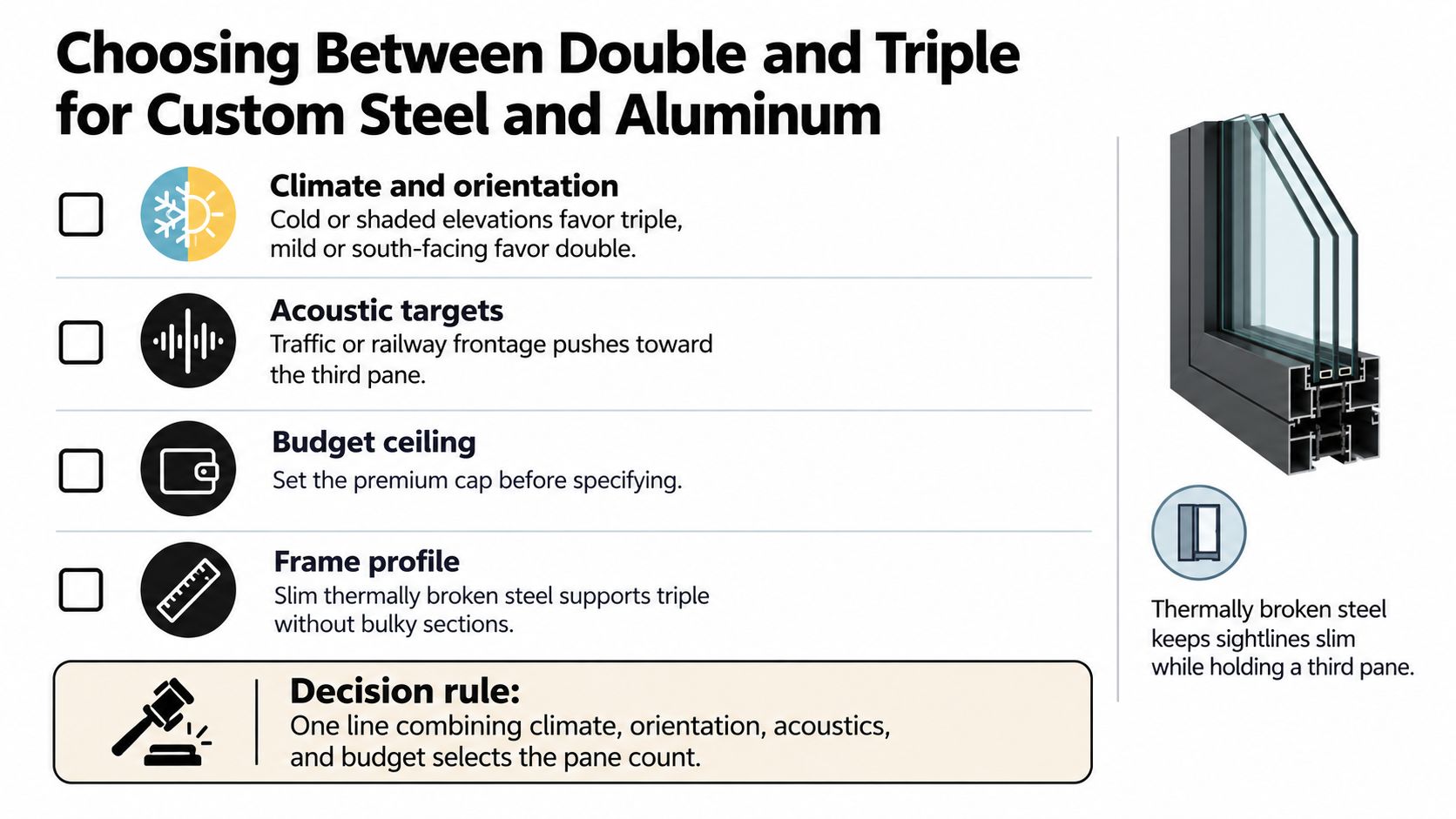
Custom metal fenestration makes the decision more exacting because the frame is both the visual feature and a major part of the thermal path. Non-thermally broken steel can conduct around an excellent glass unit. A thermally broken steel frame can preserve slim sightlines while giving the glazing a better chance to deliver its rated performance.
Use a four-part decision rule
Climate comes first. Cold and highly exposed projects deserve a serious triple-glazing review. Mixed-climate projects should usually begin with high-performance double glazing and upgrade selectively. Cooling-dominated projects should prioritize solar control and frame quality before adding glass.
Orientation changes the answer. A shaded north opening and a heavily exposed west opening need different solar strategies. Don't use one glass build-up across every elevation just to simplify procurement.
The frame must support the unit. Confirm the thermal break, glazing pocket, gasket system, drainage, and tested whole-unit performance. For aluminum, review the thermal barrier and frame depth. For steel, confirm that the metal path is interrupted where the system claims thermal performance.
Operation sets the practical limit. A fixed picture window may accept a thick triple unit with little operational penalty. A tall casement, French door, or pivot panel may perform better as a premium double if the added mass creates oversized hardware, difficult operation, or long-term adjustment problems.
A cold-climate steel project can justify triple glazing when the frame is thermally broken, the unit is factory-engineered for the sash, and the design values warmer interior edges over maximum light transmission. A mixed-climate aluminum project will often be better served by low-E double glazing with solar control tuned to each façade. A large operable unit should stop at high-performance double glazing when the third pane adds weight without solving the project's primary problem.
For a custom manufacturer, request a written comparison using the actual opening size, glass build-up, spacer, gas fill, frame, and operation type. Don't accept a center-of-glass value as a substitute for whole-unit certification. The specification should also state how the system handles glass replacement, seal failure, hardware adjustment, and warranty coverage.
Frequently Asked Questions on Double vs Triple Glazing
Does double glazing reduce condensation?
It can, when the unit raises the interior glass temperature, but condensation is controlled by the relationship between indoor humidity and surface temperature. A thermally weak frame, cold spacer, excessive humidity, or poor air circulation can still produce condensation. Condensation inside the sealed cavity indicates a failed insulating-glass seal and requires warranty review.
Can double glazing be better for noise?
Yes. Acoustic performance depends on pane thickness, asymmetry, laminated interlayers, cavity dimensions, seals, frame leakage, and the wall around the opening. A carefully designed asymmetric or laminated double unit can outperform a generic triple unit, so ask for a whole-unit acoustic rating rather than assuming that the third pane solves traffic or aircraft noise.
What payback should a U.S. homeowner expect?
There is no honest universal payback period. The Lawrence Berkeley National Laboratory analysis shows a stronger whole-home benefit in Minneapolis than in Washington, D.C. or Houston, but it also warns that results depend on window area, orientation, airtightness, HVAC efficiency, shading, and frame construction. Treat triple glazing as a climate and comfort investment, not a guaranteed bill-reduction product.
Is triple glazing overkill in a cold climate?
It can be. If the opening is small, well shaded, rarely occupied, or limited by an existing frame and hardware system, a premium double may be the better allocation of budget. Triple earns its place when the façade is exposed, the glazing area is substantial, interior edge comfort matters, or the project has a stringent whole-building energy target.
Which low-E coating should you choose?
Choose the coating around orientation, solar heat-gain targets, visible transmittance, and heating or cooling priorities. One double or triple configuration shouldn't automatically serve every elevation. Ask the glass fabricator to show the U-factor, solar heat-gain coefficient, and visible transmittance for the proposed build-up.
How long does the gas fill last?
Don't rely on a generic retention percentage. Ask for the insulating-glass construction, seal design, spacer specification, warranty term, and remedy for seal failure. Custom shapes, large panels, operable doors, and unusual edge details deserve particular attention because the warranty may distinguish them from standard units.
For a broader explanation of the comfort and energy considerations behind triple units, this guide to triple glazing benefits for NZ homes offers useful context, although U.S. climate, frame, code, and installation conditions still control the final specification.
The recommendation is clear. Choose triple glazing for a cold, exposed, comfort-driven project with a frame engineered to carry it. Choose premium double glazing when climate, solar exposure, daylight, operability, or budget make the third pane a poor trade.
For custom steel and aluminum windows and doors, Black Badge Doors offers made-to-order thermally broken assemblies with double- and triple-glazing options, slim sightlines, and configurations for residential and commercial projects. Visit Black Badge Doors with your climate, elevations, opening sizes, and performance targets ready, and request a whole-unit comparison before you approve the glass.
Read more

Pivot Exterior Doors: Engineering Guide for Designers
A pivot exterior door is often sold as a visual decision. Choose a large panel, hide the hardware, create a dramatic entrance, and the project appears finished. That advice misses the part that determines whether...
Read more
Glass Metal Doors: A Complete Specification Guide
You've found the door that makes the entire room feel finished. The sightlines are exceptionally narrow, the glass pulls daylight deep into the house, and the steel grid gives the opening an architectural presence that...
Read more