


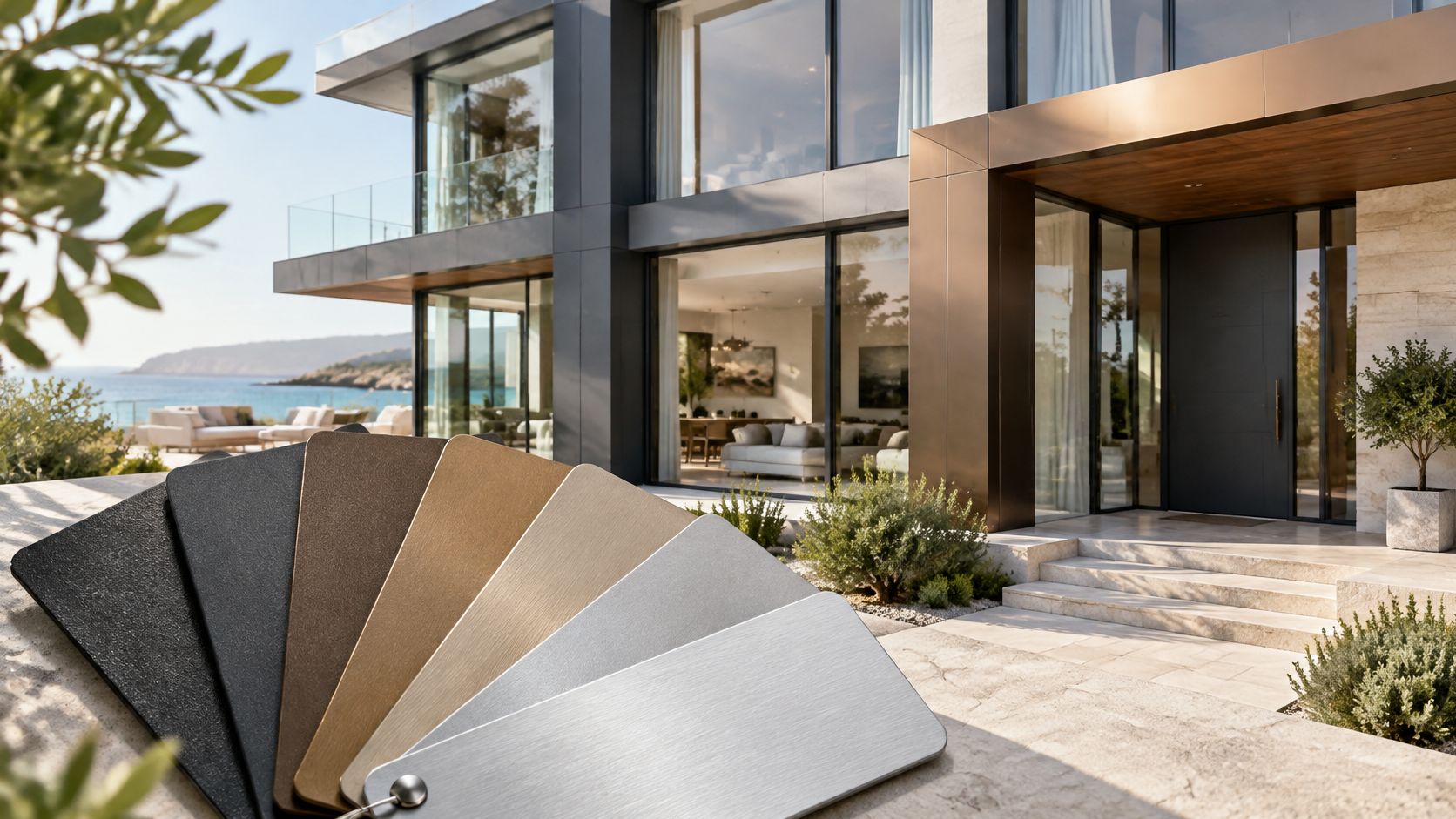
Aluminum Windows Colors: A Finish and Standards Guide
Picking a frame color from a swatch book is the most common advice in showrooms, and it's the least useful. A swatch tells you how black, bronze, or white looks under store lighting. It tells you nothing about whether that color will chalk on a west wall, fade unevenly next to brick, or run hot enough to stress sealant on a large slider.
Treat aluminum windows colors as a specification, not a decoration. The name on the chip is the smallest part of the decision. The coating system behind it, the frame construction, and the glass package decide what you live with five and ten years later.
I've seen dark frames hold up beautifully on exposed coastal elevations, and I've seen pale frames fail early because the coating was under-specified. Color alone didn't explain either result.
Table of Contents
- Why Aluminum Window Color Is a Performance Choice
- Finish Types and Color Ranges Compared
- Coating Standards and Coastal Specification
- How Dark Frame Colors Affect Heat and Performance
- Matching Frame Colors to Exterior Palettes and Trends
- Confirm the Finish Specification Before You Order
Why Aluminum Window Color Is a Performance Choice
The color name is the least useful fact on a window spec sheet. Two frames can both be called black and behave completely differently outdoors because the visible color is only a thin coating on an aluminum extrusion.
Picture a jacket. Choosing a color is choosing the dye. The fabric and stitching decide whether that dye survives years of washing. On a window, the resin, thickness, and test rating of the coating decide whether it fades, chalks, or peels.
Keep three variables separate, or you'll blame the wrong one later.
- Coating color and standard: The pigment plus the performance category it's tested to.
- Frame design: Whether there's a thermal break, meaning a non-conductive barrier between the inside and outside faces of the aluminum profile.
- Glass: The insulated unit and its low-emissivity coating, which handle most solar gain through the opening.
The basic physics
Sunlight that is reflected doesn't become heat. Sunlight that's absorbed raises surface temperature, a mechanism explained in the U.S. Department of Energy guide to reflective surfaces and absorbed solar radiation. That's why a dark exterior profile feels hotter to the touch than a white one on the same wall.
That heat matters most on non-thermally broken frames, large south and west openings, and hot climates such as Florida. Higher frame temperature can increase expansion, sealant stress, and conductive transfer through the metal.
Don't solve that by color-name alone. Coordinate the finish with a thermally broken system, low-emissivity insulated glass, and, where available, solar reflectance or solar absorptance data for the finish itself.
Working rule: Ask for the coating standard, not just the color name.
Finish Types and Color Ranges Compared
The color name tells you little about how a frame will wear. Start with the finish system: its application, thickness, and rating determine which shades it can support and how they hold up in service.
Aluminum window finish systems at a glance
| Finish system | How it is applied | Typical colors | Durability reference | Best fit |
|---|---|---|---|---|
| Liquid fluoropolymer paint (70% PVDF) | Multi-coat factory spray | Full architectural palette, custom matches | AAMA 2605 (10-year South Florida test) | Dark colors, coastal, high-sun sites |
| Polyester powder coat | Electrostatic powder cured in oven | Broad palette including bronze and black | Confirm AAMA 2603 or 2604 on data sheet | Residential and commercial, mid-exposure |
| Class I anodizing | Electrochemical oxide growth, minimum 0.7 mil | Natural, bronze and dark tones | AAMA 611 | Premium metallic look, high-wear surfaces |
| Class II anodizing | Electrochemical oxide growth, minimum 0.4 mil | Natural and bronze tones | AAMA 611 | Lower-exposure or interior-facing frames |
| Integral or electrolytic color anodizing | Color formed in or deposited into the oxide | Bronze, dark bronze, black | AAMA 611 | Matte metallic finishes with a long-lived color |
| Wood-grain or textured finish | Printed film or textured coating | Oak and walnut imitations, textured grays | Supplier test standard and warranty in writing | Warm residential facades |
Painted systems
Liquid fluoropolymer paint offers the broadest custom palette and a route to a high-performance rating. It suits dark or saturated colors on elevations exposed to strong sun and salt, provided the specific coating meets the project's requirements.
Polyester powder coat is common on residential and mid-exposure commercial frames. Color charts do not establish performance. Check the product data sheet for the stated AAMA 2603 or 2604 rating.
For a comparison with repainting existing uPVC frames rather than replacing them, Aqua Painting's uPVC window guide explains what a painted finish can and cannot do on that different substrate.
Anodized systems
Anodizing offers a narrower color range than paint, with a metallic appearance that painted finishes cannot fully reproduce. Its finish class matters on surfaces that take more wear. A mil is one thousandth of an inch: Class I anodizing has a minimum thickness of 0.7 mil, while Class II has a minimum of 0.4 mil. For example, a sill specified in Class I has a thicker anodic layer than one in Class II, making class and exposure relevant when selecting a finish.
A public-sector aluminum windows specification identifies AAMA 611 anodizing as an alternative to paint and distinguishes the minimum thicknesses for Class I and Class II. It also requires exposed aluminum with a painted finish to meet AAMA 2603-02 and a minimum dry-film thickness of 0.8 mils, as detailed in a public-sector aluminum windows specification covering coating and anodizing requirements.
The available shades can extend well beyond white. A New York City Housing Preservation and Development specification lists standard white, standard bronze, colonial white, standard ivory, beige, fashion gray, palace blue, hardwood green, river rouge red, black, silversmith, and antique bronze. The practical range depends on the specified finish system and the supplier's available colors.
Wood-grain and textured finishes
These finishes can bring a warmer look without the upkeep of real wood, but their performance evidence varies by supplier. Ask for the finish's test standard, expected color life, and warranty in writing. A realistic oak sample alone does not establish outdoor durability.
Before selecting a color, compare physical samples made on the actual extrusion. That reveals how the finish looks on the frame profile, not just on a chart, and helps catch differences in texture or sheen.
Coating Standards and Coastal Specification
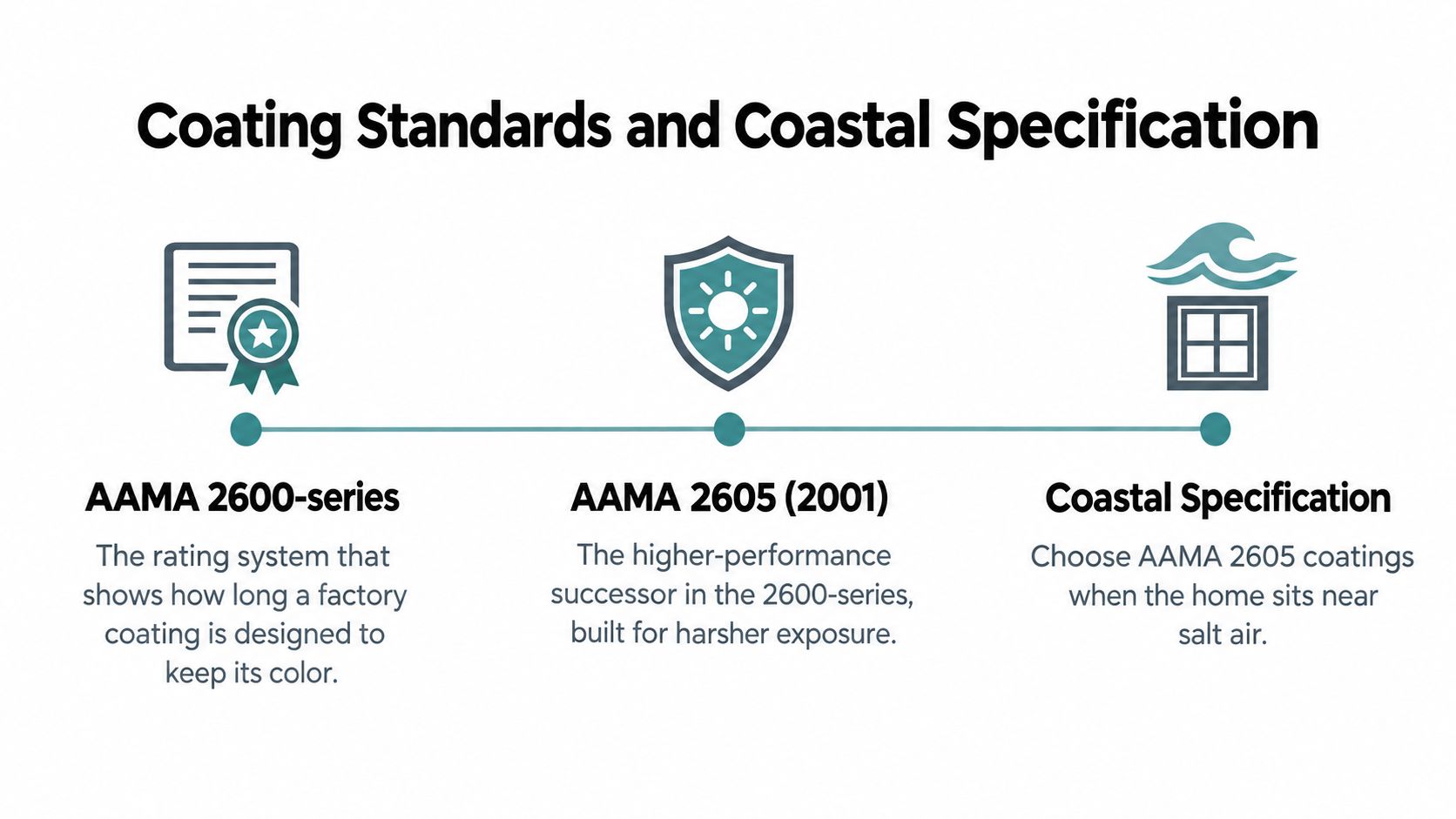
A color name tells you little about how an aluminum window will look after years outdoors. The coating standard, resin chemistry, and site exposure determine how well the finish resists fading and chalking. The AAMA 2600-series gives specifiers a way to compare factory-applied organic coatings on architectural aluminum.
What the three levels mean
AAMA 2605 was introduced in 2001 as a higher-performance successor to earlier AAMA 605 specifications, as described in the history of AAMA 2605 and coated aluminum extrusions and panels. The framework established three coating levels. PPG associates AAMA 2603 with approximately 1 year of color-retention and chalk-resistance performance, AAMA 2604 with approximately 5 years, and AAMA 2605 with approximately 10 years, in its overview of FGIA/AAMA 2605 coating requirements.
The tests cover color retention, chalk resistance, gloss retention, abrasion, salt-spray exposure, humidity, and weathering. South Florida serves as the benchmark environment because it combines strong ultraviolet exposure, heat, humidity, and salt-laden air.
FGIA/AAMA 2605 is the highest commonly referenced architectural coating performance category, designed to resist ultraviolet exposure, fading, chalking, humidity, corrosion, and salt spray. Its benchmark includes a 10-year South Florida exposure test. One reported performance target is color change of no more than 5 Delta E, chalk resistance of at least 8, and gloss retention of at least 50%, as outlined by PPG.
Delta E measures how far a color has shifted from its original. A small value indicates a close match to the approved sample. A larger shift can leave the frame looking faded or washed out.
On a sunny coastal elevation, a 2603 finish can show visible fading and chalking after two summers, especially in a dark color. Specify the coating level to suit the exposure.
Matching the reference to the site
Choose the coating category based on the site, then confirm the manufacturer's warranty in writing. These are performance categories, not warranties.
Coating reference and expected color life by site condition
| Site condition | Coating reference | Approx. color life | Color advice | Extra check |
|---|---|---|---|---|
| Mild exposure or baseline specification | AAMA 2603 | About 1 year, per PPG's coating-level guidance | Light tones only as a baseline | Not suitable for dark frames |
| Inland, moderate sun | AAMA 2604 | About 5 years, per PPG's coating-level guidance | Any palette; lighter tones lower the heat load | Standard thermally broken frame |
| Coastal, salt-laden air | AAMA 2605 with 70% PVDF or equivalent | About 10 years, per PPG's coating-level guidance | Dark colors are workable with the right resin | Salt-rinse schedule and written warranty |
| South Florida or hurricane zone | AAMA 2605 plus impact-rated assembly | About 10 years, per PPG's coating-level guidance | Dark colors need heat and expansion review | Miami-Dade approval for the assembly |
For coastal and high-sun projects, specify an AAMA 2605-compliant 70% PVDF or equivalent high-performance coating. PVDF is a fluoropolymer resin chemistry used to resist fading and chalking. Name the resin in the project documents so the supplier can confirm what is being provided.
Dark bronze, black, and other saturated finishes make fading and chalking easier to see than pale tones. Keep the coating requirements specific:
- Coating standard: State 2603, 2604, or 2605.
- Resin chemistry: Identify 70% PVDF or a stated equivalent.
- Gloss level: Specify matte, satin, or higher gloss, since gloss affects how chalking appears.
- Warranty: Confirm the covered limits for color change and chalking.
Coastal and hurricane-zone checks
Salt can affect frames without direct spray. A salt film holds moisture against the finish and can reach joints and fastener points. Include a periodic rinse schedule in the maintenance plan and give it to the owner at handover.
In hurricane-prone areas, the coating is only one part of the specification. Where required, specify an impact-rated assembly with Miami-Dade approval and review this guide to impact-resistant windows before finalizing sizes and glass. A high-performance finish does not make an unapproved assembly compliant.
A 2605 label does not remove the need for care. Regular rinsing, intact sealant, and undamaged gaskets all help preserve the appearance of frames exposed to salt air.
How Dark Frame Colors Affect Heat and Performance
A dark aluminum frame absorbs more sunlight than a light one, but color alone does not determine indoor comfort or frame durability. The coating, thermal design, glass, and exposure all affect performance. Treat color as part of the window specification, not as a stand-alone predictor.
Solar absorptance for dark pigments is around 0.70 to 0.95, compared with approximately 0.20 to 0.40 for light colors. Exposed dark profiles can reach surface temperatures of 80°C or higher in direct sun, according to this technical overview of powder coating for window and door systems. Solar absorptance measures the fraction of sunlight a surface absorbs rather than reflects, on a scale from 0 to 1.
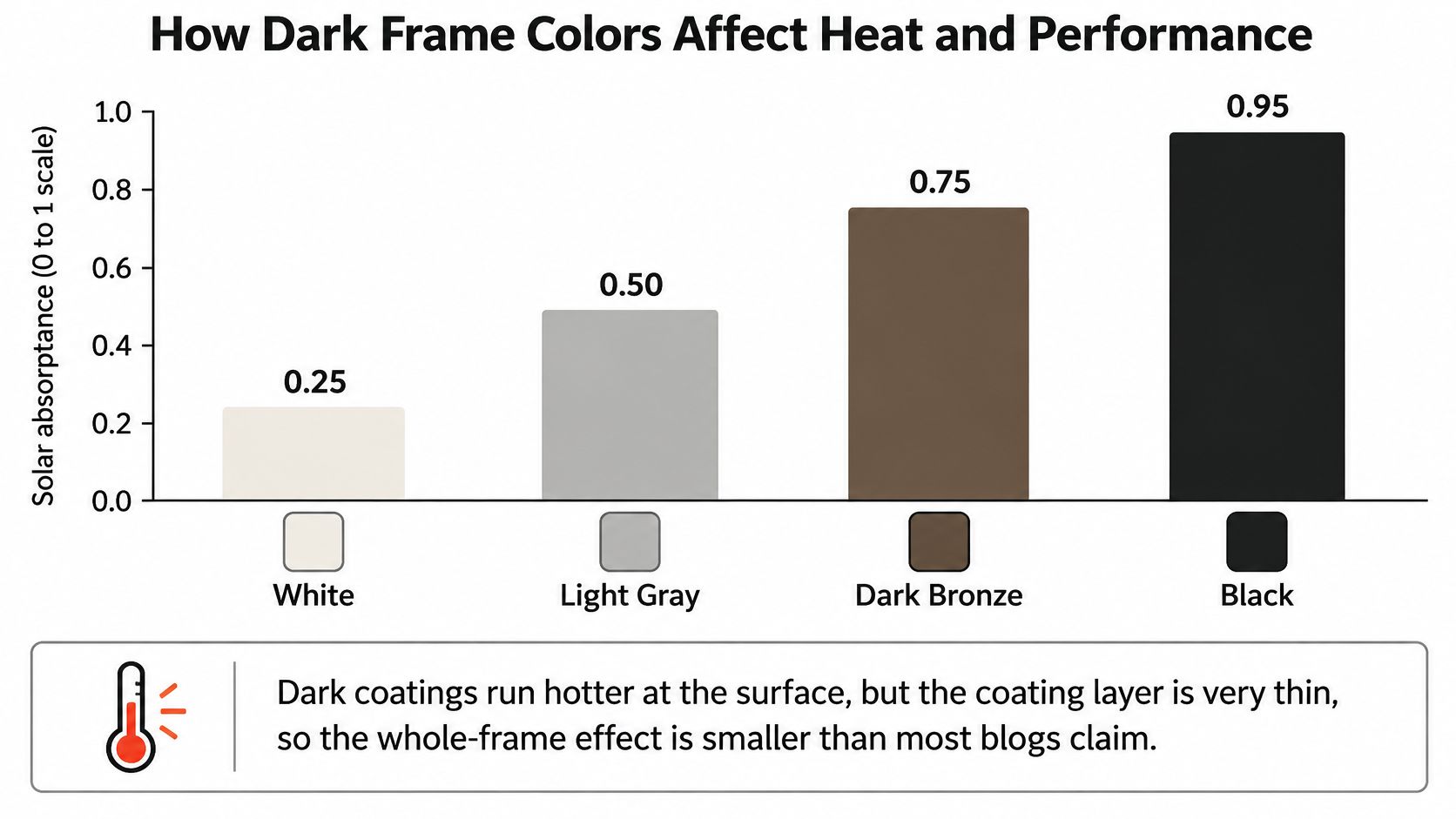
Solar absorptance and surface heat by color family, typical values; confirm with the supplier
| Color family | Solar absorptance | Exposed surface in direct sun | Specification response |
|---|---|---|---|
| Light whites, ivory, beige | 0.20 to 0.40 | Cooler than dark profiles | Standard thermally broken frame with low-e glass |
| Mid tones, medium gray, classic bronze | Between light and dark ranges, confirm with supplier | Warmer than light finishes; varies by specific color | Confirm solar data and check west and south exposure |
| Dark colors, black, dark bronze, charcoal | 0.70 to 0.95 | 80°C or higher | Thermal break, low-e glass, gasket and expansion allowance on exposed elevations |
Four terms that aren't interchangeable
These measures describe different parts of a window's performance:
- Surface temperature: How hot the exterior profile gets in sunlight. Color affects this directly.
- U-factor: The rate of heat transfer through the whole window assembly. Lower means better insulation.
- Solar heat-gain coefficient: The fraction of solar heat admitted through the window, driven mainly by the glass.
- Indoor comfort: The combined effect of frame, glass, shading, orientation, and ventilation.
The coating is a thin layer with a negligible direct effect on whole-frame thermal transmittance. A profile can feel hot outside while the assembly performs well indoors. A thermal break, an insulating barrier within the frame, interrupts heat transfer through the metal. The video showing how frame and glass choices interact illustrates why color should not be judged in isolation.
Where dark color genuinely creates risk
Direct sun still matters, especially on west- and south-facing elevations with large glass areas. A dark profile heats up and expands during the day, putting movement into gaskets, sealant joints, and long coupled frames. In a frame without a thermal break, heat also conducts more directly through the metal.
Specify details to suit the exposure. A thermally broken system, low-emissivity insulated glass, and shading where the design allows can address different parts of the heat load. For an explanation of the frame barrier and its effect on heat transfer, see this explanation of thermally broken windows.
Ask the supplier for written solar absorptance data, particularly for mid tones. Medium gray may perform closer to bronze than white, and a color name alone cannot establish its solar behavior.
A dark frame can perform well when the system is properly specified and thermally broken. A light finish does not compensate for a frame without that break. The engineering specification matters more than the color name.
Matching Frame Colors to Exterior Palettes and Trends
Start from what won't change. Roof, masonry, cladding, and trim will outlive your first landscaping plan, and the window color has to answer them every day.
Three rules handle most projects without a design degree.
- Match the undertone: Warm brick, cedar, and sand render want warm metallics or warm neutrals. Cool stucco and concrete want cool grays or black.
- Decide contrast or recede: High contrast makes thin profiles read as deliberate lines. Low contrast lets glass and wall dominate.
- Judge from the street: A sample board at arm's length lies. Distance, daylight, and shadow change how dark a frame reads.
Window colors that suit common exterior palettes
| Exterior palette | Window colors that work | Why it works |
|---|---|---|
| Modern white stucco | Black or dark bronze | High contrast and crisp lines |
| Red brick colonial | Bronze, dark bronze or white | Echoes mortar, trim and traditional detailing |
| Cedar or warm wood siding | Bronze, natural anodized or wood-grain | Metallic warmth that picks up wood tones |
| Coastal white or sand render | Charcoal or bronze | Grounds the facade without heavy contrast |
| Hardwood or sage green cladding | Hardwood green or dark bronze | Keeps the palette within one tonal family |
| Minimalist or mid-century design | Black or dark gray | Thin profiles read as drawn lines |
How to use the pairings
Black on white stucco works because the frame becomes a graphic outline around the glass. It's also unforgiving. Misaligned sightlines and uneven fading show immediately against a pale wall, which is another reason the coating standard matters.
Bronze on red brick is more forgiving and more traditional. The metallic tone picks up mortar and shadow lines instead of fighting them. White can work on the same house, but it shifts the emphasis to trim and makes the windows recede.
On cedar or warm wood siding, natural anodized and bronze keep the metallic warmth in the same family as the wood. Wood-grain finishes can work too, but check them in daylight against real siding. A printed grain that clashes with actual cedar grain looks worse than a clean bronze.
Current direction, with a durability warning
Black and dark bronze remain the default for both modern and traditional facades because they frame views without introducing another color. Textured wood-grain finishes add warmth on residential projects that want a softer elevation. Muted greens such as hardwood green show up where owners want color without a bright accent. Two-tone schemes, dark outside and light inside, are common because the interior and exterior have different jobs.
None of that overrides service life. A fashionable shade still has to hold for the coating life you specified. Check the finish standard before you fall for the trend color, and view samples in daylight on the actual building, morning and late afternoon if you can.
Confirm the Finish Specification Before You Order
Sign off on the finish only after the color, coating, frame design, and project documents agree. A color name alone cannot tell you how well a frame will hold up or manage heat. Those outcomes depend on the specified finish and the frame and glass assembly.
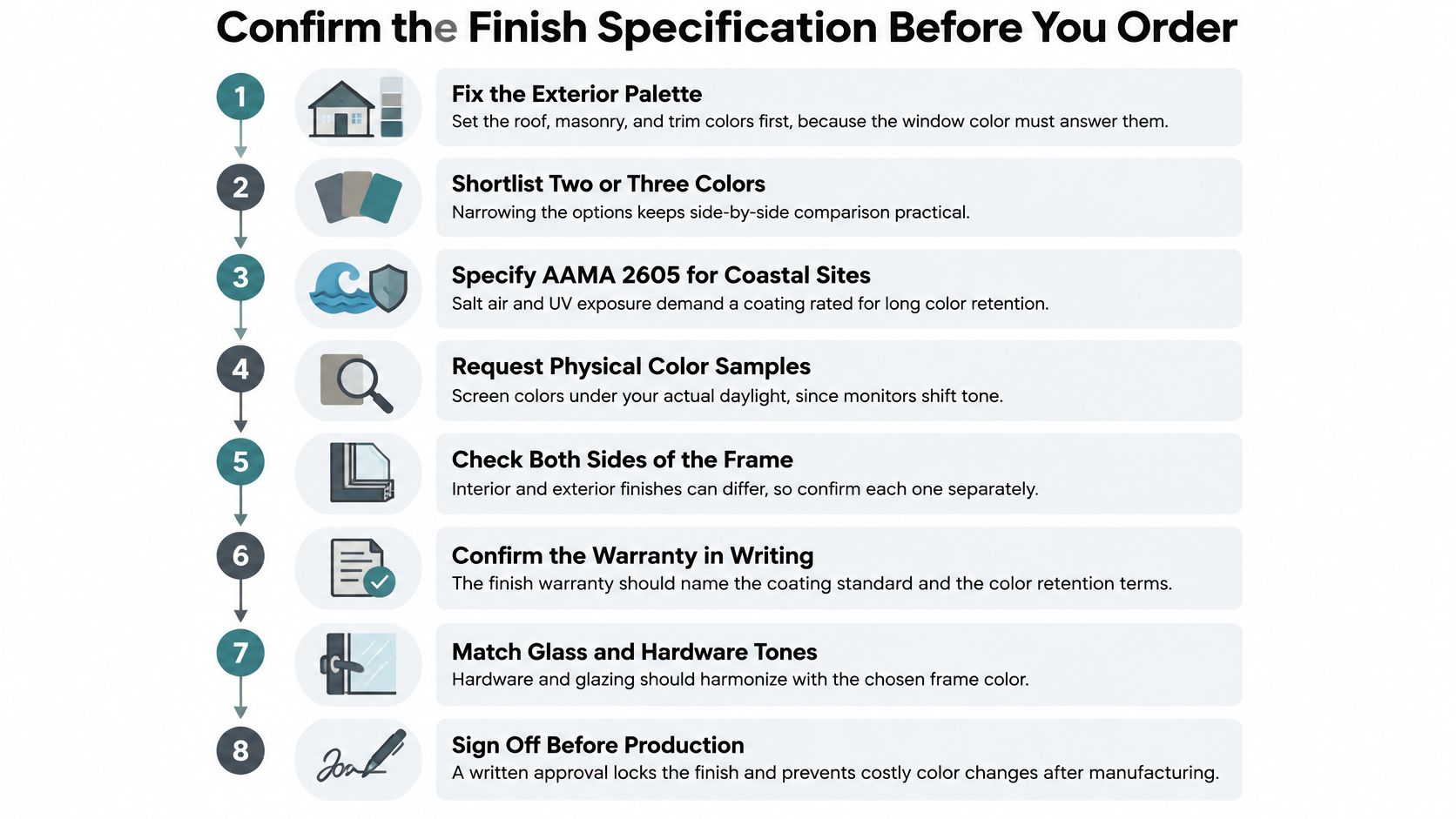
- Set the exterior palette. Confirm roof, masonry, cladding, and trim colors first. Then choose aluminum windows colors that work with those fixed materials.
- Shortlist two or three finishes. Compare samples from the finish systems you are considering, rather than judging color names alone.
- Check the sample on the building. View it in daylight on the actual extrusion, ideally on both a shaded and sunlit elevation. A chip can look different from a full frame.
- Use the site-condition table to select the coating reference for the exposure.
- Use the earlier documentation list to request written finish data for the exact product.
- Confirm thermal details on exposed elevations. For dark frames facing west or south, check the thermal break, glass specification, and gasket and expansion allowances as an assembly. The coating does not compensate for unsuitable frame or glass design.
- Record the approved finish code. Put the same code and coating standard on the order, shop drawings, and delivery paperwork. That makes an unapproved substitution easier to catch.
If openings are non-standard, confirm their dimensions while the finish is being finalized. Custom dimensions for made-to-order units can affect coupled frame lengths and expansion detailing. Settling both decisions early reduces the chance of a late change.
For custom aluminum windows or doors requiring impact-rated Miami-Dade approval, Black Badge Doors offers made-to-order units with color and texture selection, including options for Florida and Miami-Dade projects. Send the elevations, site exposure, and shortlisted finishes, and request the coating standard and warranty in writing with the unit price. Confirm that the glass and impact rating are documented for the assembly, and check that the specified finish code appears consistently across the order and project documents.
Read more
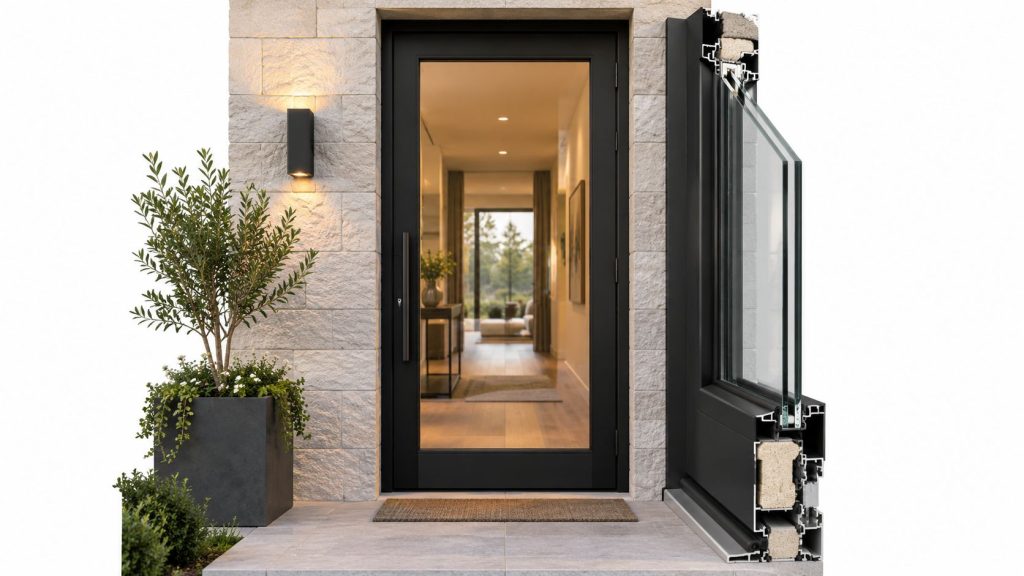
Steel Exterior Door Specs That Actually Perform
The steel door is already on the drawings. The frame is slim, the glass is large, and the elevation looks finished. Then the hard questions show up. Will that frame sweat in January? Will the...
Read more
Multi Panel Sliding Doors: Layouts, Tracks and Specs
You're looking at a wall between your living room and patio, trying to work out how much glass you can fit and where the panels will go when you open them. The drawings look simple:...
Read more