


Metal Front Door: Steel vs. Aluminum Guide for 2026
You're choosing a front door because the old one sticks, the house draft is annoying, or the elevation just looks unfinished. That decision matters more than you might expect, because the front door sets the tone at the curb and has to work as part of the building envelope every day. A metal front door earns attention when you want a cleaner look, stronger security, and a finish that can hold up to real use.
Steel remains a serious player for that reason. The global exterior doors market was valued at $28.5 billion in 2025, and steel doors held 24.8% of revenue, which makes steel the second-largest material category in that market according to Dataintelo. That's not a niche signal. It tells you metal entry systems are still being specified where strength, stability, and long service life matter.
Table of Contents
- Beyond the Threshold An Introduction
- Steel vs Aluminum The Core Decision
- Decoding Performance Energy Efficiency and Thermal Breaks
- Uncompromising Security and Lasting Durability
- Designing Your Entry The World of Finishes and Glass
- How to Specify the Right Metal Front Door
Beyond the Threshold An Introduction
A front entry can either sit naturally in the architecture or fight it. On the right project, a metal front door disappears into the composition in the best way, with crisp lines, controlled reflection, and a finish that looks intentional from the curb. On the wrong project, the same door can read as too glossy, too heavy, or too industrial for the house.
The question is whether the door works as a system. Frame, threshold, hardware, finish, and glazing all shape how it performs over time and how it looks on day one. That is why metal fits modern homes, careful renovations, and high-traffic entries. It can stay visually restrained without feeling lightweight.
A front door should handle more than appearance. If the frame, seal, and finish do not suit the climate, the door turns into a maintenance issue disguised as design.
Steel is often the first material people picture, and it earns that attention. It supports a precise architectural look and a solid feel. Aluminum comes into the conversation when corrosion resistance, lighter weight, or coastal exposure matter more. Both can work, but they solve different problems, and the surrounding assembly decides how well either one holds up.
The shipment numbers point to that practical split. Analysts in per USDA Forest Service research estimated steel door shipments at 14.8 million units globally in 2023, and hollow metal steel doors plus fire-rated steel doors accounted for about 75% of those shipments. That suggests metal front doors are still being specified for performance-driven projects, not only for appearance.
Steel vs Aluminum The Core Decision
Steel and aluminum both belong in the metal front door conversation, but they solve different problems. Steel gives a denser, more rigid feel, which suits entries where security, fire resistance, and a stronger visual presence matter. Aluminum is lighter and naturally more resistant to corrosion, so it fits coastal or moisture-prone sites better.
What steel does well
Steel is the better choice when the door needs to feel substantial in daily use and support a sharper, more traditional-to-modern profile. It also aligns with the performance-driven end of the market, especially in hollow metal and fire-rated applications.
That matters because the door is judged by touch before anyone studies the spec sheet.
Steel also gives you more room to engineer the full system around the opening. A proper frame, insulated core, thermal break, and durable coating can turn a steel entry into a reliable assembly. Skip those pieces, and the door becomes a heat bridge with a finish that needs more care than it should.
What aluminum does well
Aluminum makes sense where corrosion resistance comes first. It is lighter to operate, and that can simplify long-term upkeep in coastal environments. It also works well in some impact-rated assemblies and in modern profiles where managing weight matters.
The trade-off is simple. Aluminum does not carry the same sense of heft as steel, and some homeowners want that more solid feel at the front door. That is not a flaw. It is a different design choice.
Comparison of Steel and Aluminum Front Doors
| Attribute | Steel Doors | Aluminum Doors |
|---|---|---|
| Strength and rigidity | Very high, with a substantial feel | Good, but generally lighter in feel |
| Corrosion resistance | Depends heavily on coating and maintenance | Naturally stronger in corrosive settings |
| Visual character | Crisp, solid, architectural | Clean, modern, lightweight |
| Best fit | Security-focused and fire-rated entries | Coastal and corrosion-sensitive projects |
| Thermal behavior | Needs insulation and thermal breaks | Also needs careful assembly design |
| Maintenance profile | Finish upkeep matters a lot | Typically easier in harsh exposure |
The smartest spec is not the heaviest material. It is the one that matches the site, the use pattern, and the look you need to carry through the facade.
Decoding Performance Energy Efficiency and Thermal Breaks
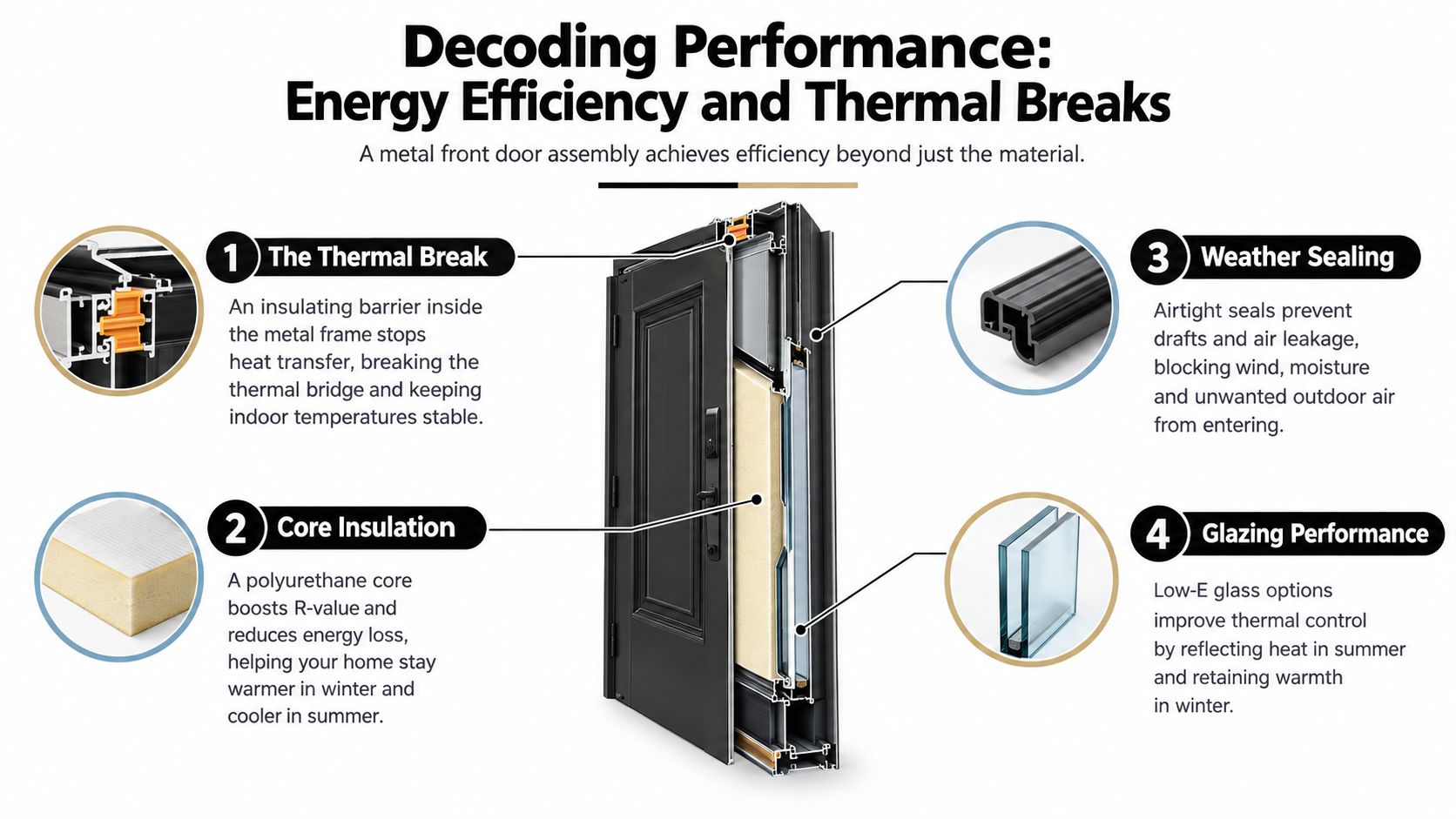
A metal front door performs only as well as the assembly around it. That is the part many buyers miss. The leaf is one piece. The frame, threshold, weatherstripping, glazing, and installation details decide whether the opening feels tight in January or leaks air all year.
Why the whole assembly matters
The Steel Door Institute says energy-efficient exterior openings should be tested as fully operable insulated door-and-frame systems under ASTM C1363, not as the door leaf alone Steel Door Institute sample specification. That is the right way to judge performance. A winter coat keeps heat in because the layers, seams, and closures all work together.
The same source shows that an operable insulated steel door and frame system with a thermal break can achieve U-factors as low as 0.374 and R-values of 2.53 when the assembly is tested as a unit. Those figures only matter if the frame and seals are built into the spec.
How thermal breaks change the result
Bare steel conducts heat quickly. BRE's guidance places mild steel, including galvanized steel, at about 50 W/m·K thermal conductivity, which is why an unbroken metal path moves heat so efficiently BRE guidance. A thermal break interrupts that path. It stops outdoor temperature from traveling straight through the metal.
A good door spec usually combines:
- Insulated core construction, to reduce heat flow through the leaf.
- Thermally broken frame sections, to reduce edge transfer.
- Tight perimeter sealing, to control drafts and air leakage.
- Proper threshold detailing, so the bottom of the opening does not undermine the rest of the system.
Practical rule: If a quote talks about the door panel but not the frame and threshold, you are not looking at a full performance specification yet.
The Steel Door Institute also cites exterior door air leakage limits of 0.25 cfm/ft² at 1.567 psf pressure differential. That keeps the focus where it belongs, on both thermal performance and airtightness. A door that insulates well but leaks at the edges still underperforms.
Uncompromising Security and Lasting Durability
A metal front door only performs as well as the system around it. The leaf, frame, threshold, hinges, and locks all have to work together, or the weak point shows up fast. Steel and aluminum both handle impact better than many traditional entry materials, which matters on an entry that gets slammed, bumped by luggage, used by kids, and exposed to weather every day. The door should stay aligned while taking that abuse.
Steel remains the default choice for projects that prioritize security and long service life. It carries more of the market because specifiers keep returning to it where fire resistance, impact resistance, and durability need to hold up under use USDA Forest Service research. That preference usually reflects the whole assembly, not just the skin of the door.
Hardware is part of the security story
A strong leaf without serious hardware is only half a solution. Multi-point locking, reinforced strike areas, and a frame anchored correctly do more for real security than marketing copy ever will. Forced-entry pressure concentrates at the jamb and lock side, so the frame and reinforcement details matter as much as the slab itself.
Architects and homeowners should also look at the opening as a connected set of vulnerable points. The same thinking applies to glazing, which is why a guide to impact-resistant windows is a useful companion reference. Door security, window protection, and frame detailing all need to match the exposure of the site.
Durability is about movement and finish
Long-term durability starts with stable geometry. A properly fabricated metal door should not swell like wood, and it should not twist out of alignment because the season changed. What usually fails first is the finish system, the hinges, or the weather seal around it.
One season of sticking usually points to installation errors, frame movement, or finish damage, not a problem with metal itself.
Service life depends on the whole assembly staying true. Good fabrication, correct installation, and hardware that suits the opening keep the door operating cleanly. Care should stay light if the specification was right from the start.
Designing Your Entry The World of Finishes and Glass
A metal door can read quiet and architectural or bold and expressive, and the finish sets that tone. Factory paint gives consistent color and a crisp contemporary look. Powder coating usually gives a harder, more even surface for projects where the front door takes visual center stage.
The layer under the color matters just as much. Exterior steel doors often use hot-dipped zinc-coated steel, and the Steel Door Institute sample specifies ASTM A924 A60 before the paint system is applied Steel Door Institute specification. That base coating helps because steel conducts heat and is vulnerable to rust, so the protection stack carries most of the performance and appearance burden.
Coatings are not just cosmetic
A coated steel door in humid or coastal conditions needs more than a good color. It needs a barrier system. Zinc-coated substrates, durable paint, clean edges, and routine finish care all work together to slow corrosion. If one layer fails, the others have to absorb the exposure.
Glass choice belongs in the same conversation. Clear insulated glass brings in light and keeps the entry visually open. Frosted or ribbed glass gives privacy without flattening the facade. Fluted glazing can soften a hard exterior and still keep the door feeling contemporary.
For a useful interior reference, see this arch glass doors interior reference. It shows how glass shape and framing change the character of an opening without making it visually heavy.
Coastal exposure changes the spec
Coastal projects need closer scrutiny. Broad advice that says steel is durable skips the issue, which is exposure and finish quality. The WBDG notes that Grade 316L stainless steel is preferred in corrosive environments, and some steel frame specifications call for back-coating with bituminous protection. That does not mean steel cannot work near the sea, it means the coating and base-metal choice have to match the site.
A metal door can look expensive for years, but only if the finish system is treated as a technical component, not a decorative afterthought.
How to Specify the Right Metal Front Door
Start with the site, not the style board. An inland project that prioritizes energy performance may call for insulated steel with a thermally broken frame. A coastal home needs a different spec, because corrosion resistance depends on the base metal, the coating stack, and the quality of the finish system.
Specify the opening as a complete assembly. Ask what frame section is being used, how the threshold is detailed, how the seals are set out, and whether the door is tested as a full unit. If the conversation only covers the slab, the spec is incomplete.
The frame and threshold often decide how the door performs after installation. Poor detailing there leads to drafts, water entry, and premature wear, even if the face of the door looks refined. That is the part many buyers miss.
For projects where the entry has to sit in step with adjacent glazing, this custom-made windows and doors reference shows how custom sizing and profile choices affect the overall composition without forcing every opening to look identical.
Questions worth asking before you order
- What climate exposure are we designing for? Coastal, hot-humid, mixed, and cold conditions all push the spec in different directions.
- Is the frame thermally broken? If not, the door may present well and still underperform.
- What coating system is on the base steel? Substrate and finish both affect longevity.
- How is the threshold detailed? This is a common source of drafts and water intrusion.
- What glazing and privacy level fit the entry? Clear, frosted, ribbed, or decorative glass changes both performance and curb appeal.
- What hardware package is included? Locks, hinges, and strikes should be specified with the rest of the assembly.
For multi-opening projects, the guide to integrated door entry helps show how access control and entry components need to work together across the building.
As noted earlier in the WBDG guidance, exterior door performance depends on the system, not just the leaf. A thoughtful spec reduces callbacks, repainting, and complaints because the frame, threshold, finish, and hardware are matched to the site. That is what a well-chosen metal front door delivers, a sharp first impression and performance that still holds up after years of use.
Read more

8 Arch Glass Doors Interior Ideas for Modern Spaces
A lot of people arrive at arch glass doors interior projects the same way. The rectangular opening is functional, but it feels dead. It doesn't carry enough light, it doesn't relate to other curves in...
Read more
Inswing Casement Window: A Practical Guide for 2026
You're standing in a kitchen where the exterior walkway is too narrow for an outward-opening sash, while the interior layout leaves only a small gap between the window and the island. A standard casement solves...
Read more