


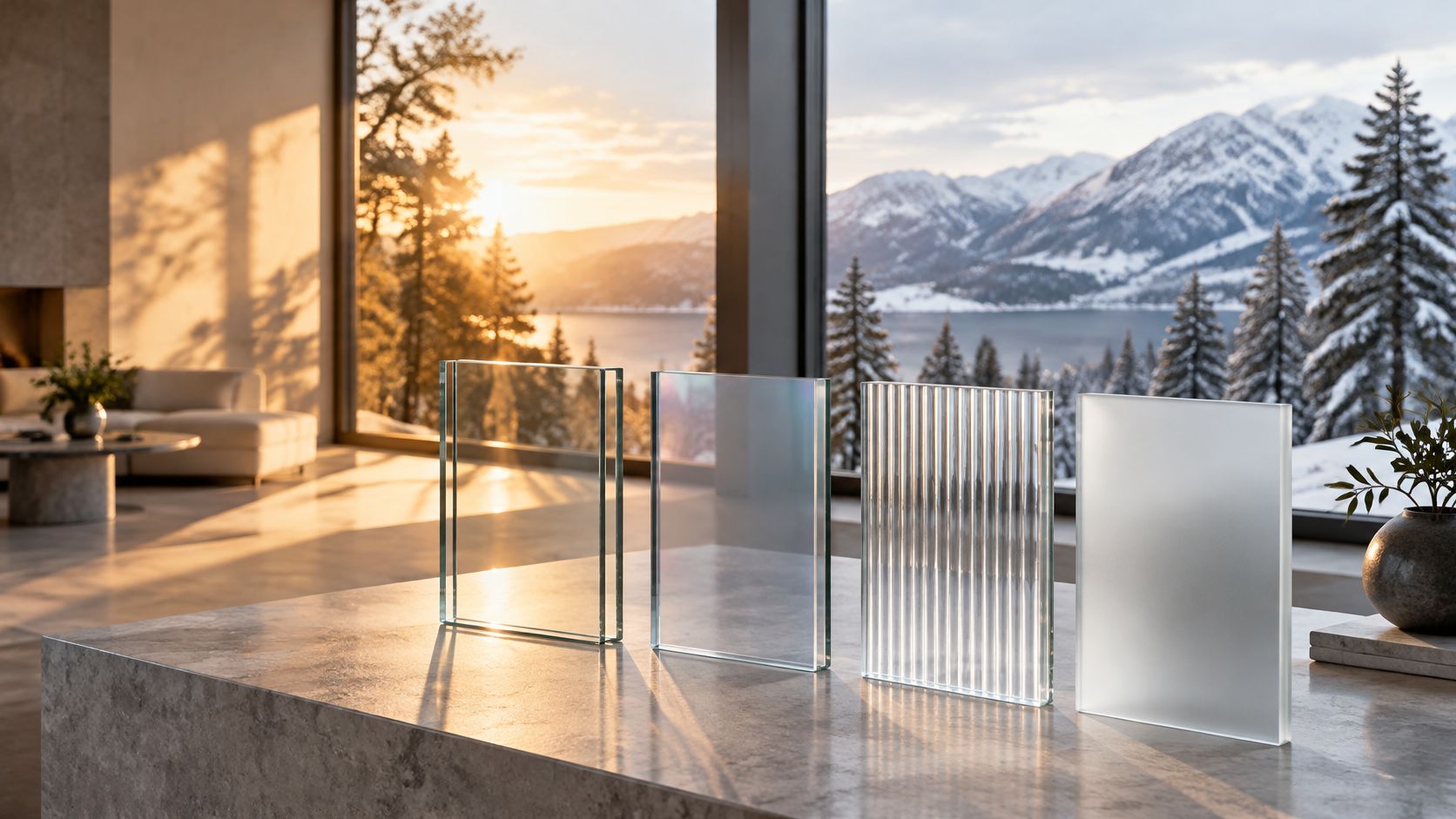
Glass Options for Windows by Climate and Use
A west-facing steel picture window can look flawless on the elevation drawing and still make a kitchen uncomfortable by late afternoon. A north-facing casement in the same house may get little direct sun and need a very different priority: limiting heat loss without unnecessarily darkening the room. Those openings shouldn't automatically receive the same glass package just because they share a frame style.
Low-E coatings are now used in more than 80% of U.S. residential window sales, and a properly selected coating can reduce window-related energy use by approximately 30–40%. The actual result depends on climate, orientation, solar heat gain, frame design, and installation quality, as explained in this overview of window technology. In a steel or aluminum opening, glass and frame have to be specified together: the coating manages radiant heat, while the glazing cavity and frame affect heat transfer through the assembly.
Start with the job each opening has to do. Compare glass types, read whole-window performance numbers, choose a target for each exposure, then select safety glass and privacy texture separately. For help thinking through furnishings and daylight in a shared living space, these living room window ideas from Giorgi Bros. Furniture can help you consider window treatments alongside the glass. The aim is a specific glass makeup for each opening, not one finish chosen for the whole house.
Table of Contents
- Why Pane Count Is the Wrong First Question
- Glass Options Compared at a Glance
- U-Factor SHGC and Sound Side by Side
- Glazing Targets by Climate and Exposure
- Safety Privacy and Patterned Glass
- What Steel and Aluminum Frames Can Hold
- Specify the Glazing Package for Each Opening
Why Pane Count Is the Wrong First Question
A west-facing kitchen opening and a north-facing bedroom opening can share the same dimensions and still need different glazing. The kitchen may call for lower solar heat gain to limit afternoon heat and glare. The bedroom may need lower heat loss while retaining useful daylight. Choose for the elevation and room, not by ordering the same pane count everywhere.
Pane count is only one part of the specification. Double glazing is a common starting point, while triple glazing may suit more demanding conditions. Neither tells you the window's U-factor or SHGC, whether the glass suits the exposure, or whether the frame can accommodate the unit's thickness and weight. Texture serves another purpose: fluted, rain, or frosted glass can soften views, but does not by itself improve thermal performance.
Specify the opening, not just the glass. Record its climate, orientation, room use, frame depth, and safety needs before choosing a glazing package.
Set the performance targets for each elevation, then choose the glass makeup and check that the frame can hold it. Select safety treatment and privacy texture separately; they address different requirements. For ideas on coordinating furnishings and daylight, see these living room window ideas from Giorgi Bros. Finally, put the complete specification in the quote request so pane count, performance, and finish are not mistaken for one another.
Glass Options Compared at a Glance
| Option | Typical makeup | Main job | Limit |
|---|---|---|---|
| Annealed single pane | One clear lite | Interior partitions where code allows | High heat loss; large shards if it breaks |
| Fully tempered | Heat-treated lite, often in an IGU | Doors, low glass, thermal-stress resistance | About 4x annealed strength but no fragment retention |
| Laminated safety | Two lites with a polymer interlayer | Overhead, security, impact, fallout control | Heavier; a glass label isn't a rated frame assembly |
| Double low-E with argon | Two panes, one low-E, sealed argon cavity | Default home package near U 0.30 | Weak for severe cold or high noise |
| Triple glazing | Three panes, often two coatings and gas | Cold climate, premium efficiency, quieter rooms | Weight, depth, cost; about 1.4% of U.S. sales |
| Passive or solar-control low-E | Coating tuned for higher or lower SHGC | South glass in cold climates versus hot elevations | Wrong coating blocks winter sun or allows overheating |
| Fluted or ribbed | Linear texture, usually tempered | Privacy with daylight in baths and partitions | Distorts the view; not an insulation upgrade |
| Rain glass | Irregular water-like texture | Soft privacy without a full frost | Obscures detail; texture alone doesn't change thermal performance |
| Frosted or acid-etched | Diffusing face or interlayer | Street lites, baths, patterned bird safety | Lower clarity and visible transmittance |
| Acoustic laminated IGU | Asymmetric panes and acoustic interlayer | Street, airport, or courtyard noise | Needs a tested whole-unit sound rating |
For many homes, the sensible starting point is double glazing with argon and one low-E coating, then adjusted for the opening's exposure and frame. The U.S. Department of Energy's guide to energy-efficient windows describes this as a typical high-performance residential configuration, aiming near a U-factor of 0.30 and an SHGC below 0.30. Its market information also reports that low-E/argon windows rated around R-3 account for more than 86% of annual U.S. window sales, while triple-pane products remain a niche at roughly 1.4%.
Triple glazing is a special-purpose choice, not an automatic upgrade. It can suit a cold-climate opening, a stringent efficiency target, or a room where a more complex acoustic build is justified. But the additional panes make the unit heavier and deeper, so the frame, sash, and hardware have to be suitable for it. For inspiration when planning a light-filled addition, this guide to planning a warmer garden room from TimberLodge365 offers useful context for balancing glazing choices with how the room will be used.
Treat privacy and safety as separate decisions from insulation. Fluted, rain, and frosted glass change the view and diffusion of light; they don't improve thermal performance unless they're part of a complete insulated glazing unit. Likewise, a glass type chosen for sound control should come with a tested rating for the complete window. Pick the row that matches the opening's job, then check the actual performance figures before ordering.
U-Factor SHGC and Sound Side by Side
A whole-window rating can differ from the centre-of-glass performance. U-factor measures heat flow through the complete product; lower means better insulation. SHGC runs from 0 to 1; lower values admit less solar heat. Glass, spacer, frame, and window size all affect the result.
| Package | U-factor | SHGC | Light and sound note |
|---|---|---|---|
| Single clear | Typically about 1.0 | Typically about 0.8 | High light transmission; weak insulation and modest sound control |
| Double clear | Typically about 0.5 | Typically about 0.7 | Better insulation than single glazing, but a weak energy package |
| Double low-E argon | Near 0.30 | Below 0.30 in a high-performance spec | Coating sets solar gain; the package is common in U.S. homes |
| Cold-climate moderate low-E reference | 0.28 | 0.31 | DOE whole-window example in a nonmetal frame |
| Triple low-E | Typically about 0.2 to 0.3 | Depends on coating and glass makeup | Better insulation, often less light, with added weight and depth |
| Electrochromic | Typically about 0.2 to 0.4 | 0.09 to 0.47 | Visible transmittance ranges from 0.02 to 0.62 as tint changes |
Typical values are comparison points, not order specifications. Actual ratings vary with the glass makeup and complete window. The U.S. Department of Energy's window performance guide gives a cold-climate reference of U-factor 0.28 and SHGC 0.31 for moderate-solar-gain low-E glazing in a nonmetal frame. That is a whole-window example. For thermally broken steel, request NFRC-rated whole-unit figures for the exact frame, glass makeup, spacer, and size. Learn how thermally broken window frames affect performance before settling the glazing specification.
Visible transmittance describes how much visible light passes through. Coatings, tints, and diffusing finishes can change daylight and glare even when glass thickness is similar. Electrochromic glass varies with tint state, so compare its ratings at the state that suits the room.
Sound needs its own specification. Laminated glass and differing pane thicknesses can be used in sound-focused units, but the tested STC or OITC rating for the complete window is the meaningful comparison. Centre-of-glass performance does not establish how the full assembly will perform.
A coating or texture can change solar gain and visible light without making the glass look substantially thicker. Use ratings for the exact window makeup, not a glass-only estimate.
Glazing Targets by Climate and Exposure
| Exposure | Cold or mixed climate | Cooling-dominated climate | Why |
|---|---|---|---|
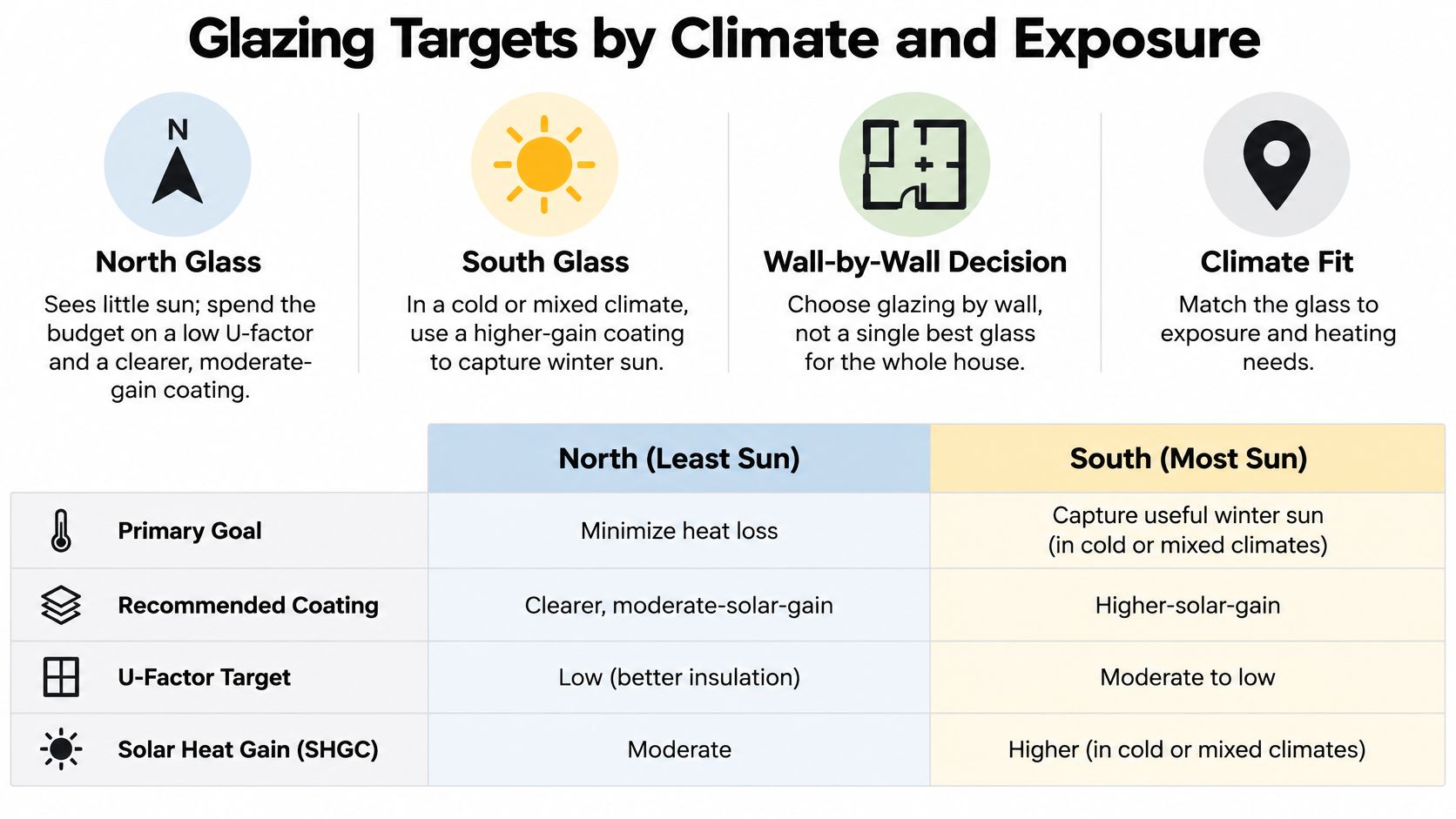
| North | Low U-factor, moderate SHGC, clear double or triple | Low U-factor, moderate-low SHGC | Little direct sun; insulation matters most |
| South | Higher SHGC if an overhang exists | Low SHGC solar-control low-E | Winter gain is useful only when summer sun is shaded |
| East | Lower SHGC plus exterior shade | Lowest practical SHGC or dynamic tint | Low-angle morning sun bypasses most overhangs |
| West | Lower SHGC, screens, or shade | Lowest practical SHGC; avoid a dark fixed tint if winter light matters | Afternoon overheating is the common failure |
| Large picture wall | Size the coating to that exposure, not the house average | Same, and watch glare | Slim frames make a bad coating more obvious |
South and west glass shouldn't be treated as interchangeable. In a cold or mixed climate, a south-facing room may benefit from winter sun if an overhang blocks the higher summer sun. A west-facing kitchen, by contrast, can take direct low-angle afternoon sun that a typical overhang won't stop. That room may need lower solar gain, an exterior screen, or another form of exterior shade.
Glazing can reduce heat transfer and still contribute to summer overheating or winter glare. A peer-reviewed review discusses those competing effects, while a 2025 optimization study identifies east- and west-facing windows as needing lower SHGC because low-angle sunlight can create summer overheating risk. The same review notes electrochromic glazing as a potential cooling-climate choice, reporting SHGC of 0.09–0.47 and visible transmittance of 0.02–0.62, as described in this review of glazing performance and orientation.
In a cooling-dominated climate, a solar-control coating or effective exterior shade may do more for comfort than adding panes that still admit unwanted solar heat. In a cold climate, an insulated triple unit may be worth evaluating for a large north-facing or wind-exposed opening, while a sunny south-facing opening could call for a different coating. Consider the room as well as the compass direction: a west kitchen used in the afternoon has a different comfort challenge from a north bedroom used at night.
One line for each elevation: north, prioritize insulation and preserve useful daylight; south, balance winter gain against summer shading; east and west, control low-angle sun; large picture wall, specify for its actual orientation rather than the house average.
For broad expanses of glass, the right treatment can be as important as the glass package. These ideas for window treatments for oversized windows from Lewis and Sheron Textiles can help you consider interior light control alongside exterior shading. For impact-resistant options, see this guide to impact-resistant laminated glass.
Safety Privacy and Patterned Glass
Tempered and laminated glass solve different breakage problems. Fully tempered glass is approximately four times as strong as annealed glass of the same thickness and configuration; if it breaks, it disintegrates into relatively small fragments. Laminated glass has a polymer interlayer that holds broken pieces together, which helps reduce fallout, intrusion, and injury risk. The National Glass Association's laminated-glass guidance describes why fragment retention matters for overhead glazing, security, and impact applications.
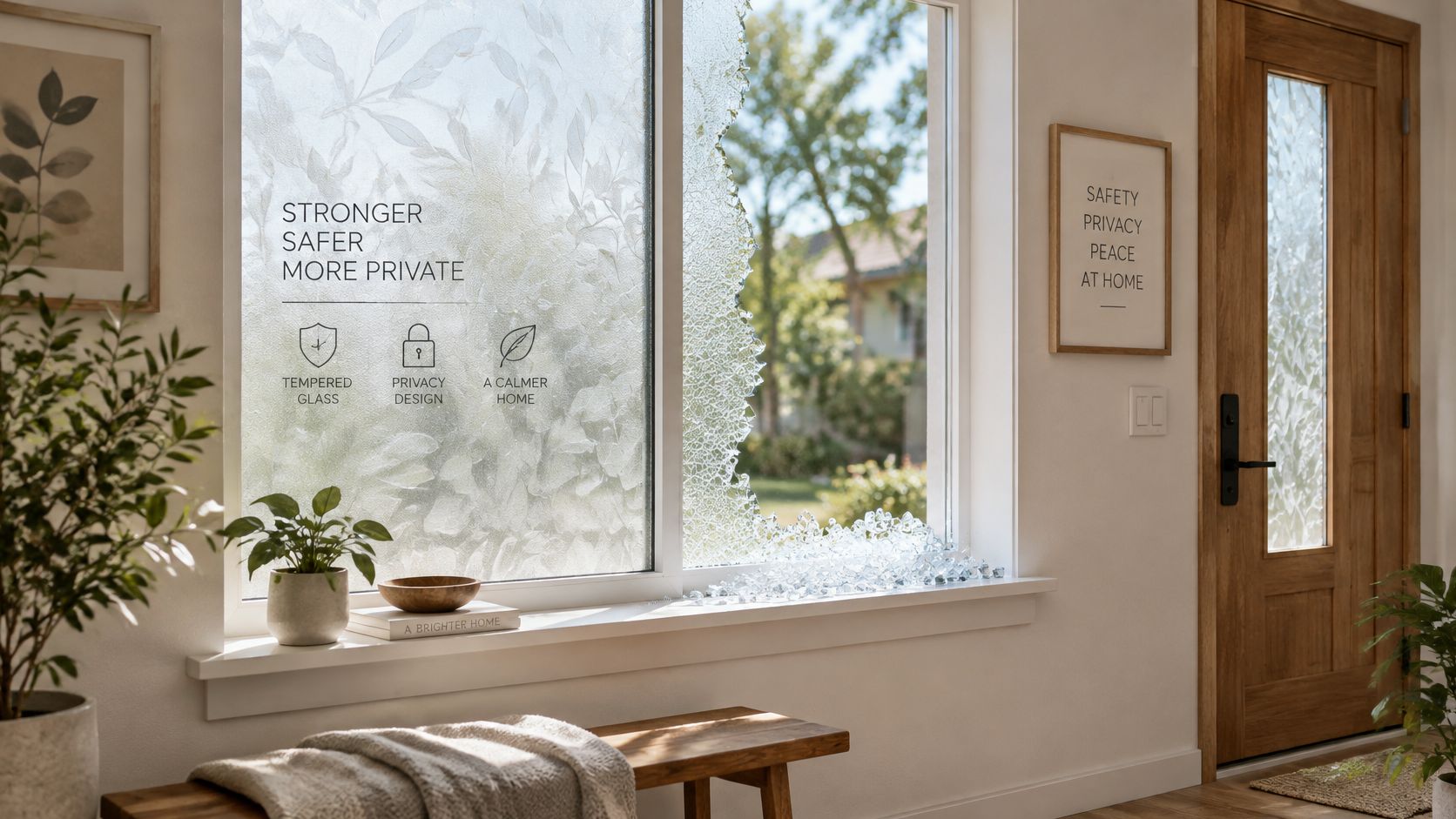
Use tempered glass where safer fragmentation and thermal-stress resistance are the main priorities, such as doors and low lites where safety-glazing rules apply. Choose laminated glass when the pieces need to remain attached to an interlayer, including in overhead applications or where security and impact performance are central. Neither label alone establishes that an opening complies with code. The installed assembly must meet applicable requirements, which may include ANSI Z97.1 or CPSC 16 CFR 1201. Confirm the tested frame-and-glass configuration, including its thickness, treatment, edges, hardware, and framing.
Choose privacy texture for its view
Fluted or ribbed glass interrupts a view with linear texture while allowing daylight through, making it a useful privacy option for partitions and baths. Rain glass softens detail without creating the more uniform blur of a full frost. Frosted or acid-etched glass diffuses the view more strongly, but that comes at the cost of clarity and visible transmittance.
For bird safety, exterior markers should be spaced no farther apart than 2 inches by 2 inches, following U.S. Fish and Wildlife Service guidance. Frit, etched or frosted patterns, UV-reflective treatments, and exterior screens can be integrated into a design. The markers need to address the exterior surface, where reflections and apparent open flight paths occur; a small interior decal isn't an equivalent treatment.
A fine exterior frit can preserve more of the outlook than a full frost while adding a visible pattern to clear insulated glass. For a detailed look at textured glazing, this article on rain glass windows explores one approach to privacy and light. On the order, name the safety category and texture separately from the pane count.
For a visual overview of breakage and glazing, watch this window glass safety video.
What Steel and Aluminum Frames Can Hold
| Frame type | Glass build it can carry | Thermal note | Limit |
|---|---|---|---|
| Thermally broken steel casement | Double low-E argon, tempered where required | Break stops edge conduction | Sash weight limits glazing depth |
| Thermally broken steel fixed picture | Double or triple low-E, tempered | Triple suits fixed units more than operable sashes | Needs deeper rebate and heavier frame |
| Solid or hollow steel interior | Single tempered, fluted, or frosted | No energy code across the partition | Not an exterior thermal solution |
| Aluminum standard thermal break | Double low-E argon with warm-edge spacer | Warm-edge spacer protects the U-factor | Krypton only for slim cavities |
| Aluminum coastal impact | Laminated or impact IGU as a tested assembly | Tested configuration only | A residential low-E unit doesn't qualify |
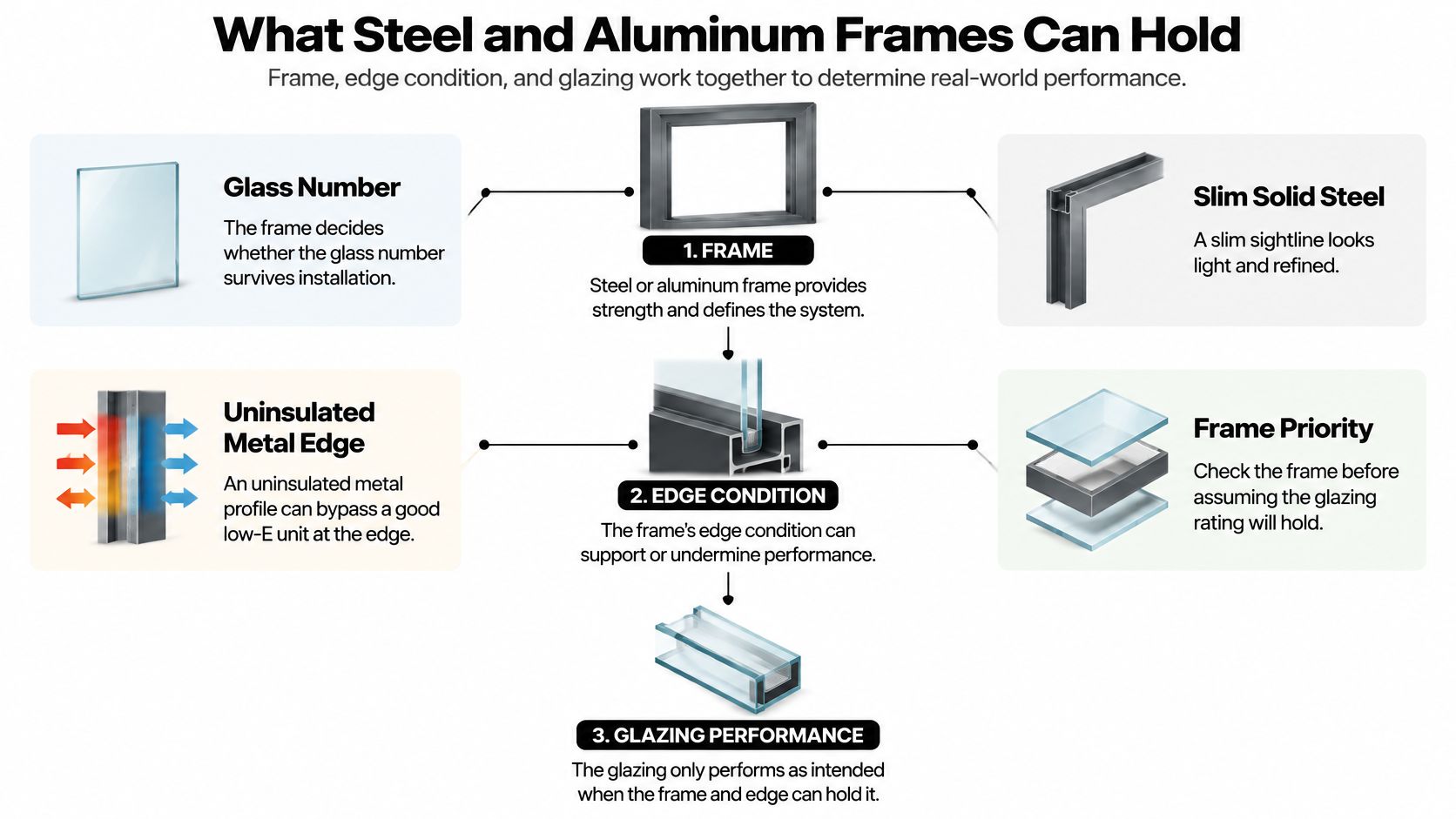
The frame decides whether the glass specification works as intended once the window is assembled. A slim metal sightline may suit a design, but an uninsulated metal edge can compromise the thermal performance expected from the glazing. For exterior steel in cold or mixed climates, look for a thermal break as part of the frame design, not as a feature assumed from the glass quote.
Glass weight and glazing depth set practical limits. Double glazing with argon is a common fit for thermally broken metal systems, while a third pane needs more depth and adds weight to the sash and hardware. That makes triple glazing easier to accommodate in a fixed picture unit than in a large operable casement. If the frame can't take the specified unit, changing coatings won't solve the fit problem.
Check the edge and the operating hardware
A warm-edge spacer helps limit heat transfer around the perimeter of an insulated glass unit. The spacer, frame, and sash all influence the whole-window rating, so request NFRC U-factor and SHGC for the exact profile, glass makeup, spacer, and size. If a slim cavity limits the gas-fill choice, discuss the glass and profile as a coordinated build rather than assuming any gas or pane count will fit.
Interior steel partitions are a different application. They don't separate indoor and outdoor conditions, so single tempered, fluted, or frosted glass may meet the design goal without an exterior thermal package. For a divided-light appearance, simulated divided lites sit on an insulated glass unit; true divided lites separate the panes and can affect the assembly's thermal performance and sightline.
Coastal impact work has another constraint: the glass and frame must be tested as the intended assembly. An ordinary residential low-E unit isn't a substitute for a tested impact configuration. When a profile can't accept the glass depth or weight, change the frame or glazing build rather than relying on a coating change to overcome a physical limit.
Specify the Glazing Package for Each Opening
Write each opening as a line item before you choose finish samples. Include operation, size, exposure, climate, glass makeup, frame, and extras. That gives the supplier the information needed to check weight, frame depth, safety requirements, and whole-unit performance.
- West kitchen casement: hot climate; solar-control low-E double glazing with argon; tempered where required; thermally broken steel; exterior shading specified separately.
- North picture window: cold climate; triple glazing or thermal-break double low-E with a moderate SHGC; warm-edge spacer; clear glass.
- Bath or street-facing lite: insulated unit with fluted or frosted glass on the required safety lite; add laminated glass where overhead, security, or impact conditions call for fragment retention.
- Large clear wall facing habitat: selected low-E package with an exterior bird-safe pattern spaced to meet the applicable guidance.
Request the NFRC whole-unit U-factor and SHGC for the exact frame, dimensions, glass, and spacer, plus the tested safety-glazing rating and any impact documentation required for the project. Include the opening size, fixed or operating type, city, and one complete glass line for every unit.
Black Badge Doors makes custom steel windows and doors, including thermally broken assemblies, and offers an aluminum line for impact-rated coastal work. Send the opening schedule and glass line for each opening to Black Badge Doors to discuss a made-to-order configuration that matches the frame, exposure, and glass requirements.
For a renovation or new build, prepare one glass specification per opening before requesting a quote. Black Badge Doors offers made-to-order steel windows and doors, thermally broken options, and aluminum configurations for impact-rated coastal projects. Visit Black Badge Doors with your opening sizes, operating types, city, and glazing lines to discuss the right frame and glass combination for your project.
Read more
Arched Transom Window Guide: Shapes, Specs and Glazing
You've sketched a front door, picked a finish, and now you're staring at the space above it. You want the curve you saw on a Georgian entry, but you're not sure what to call it,...
Read more
Triple Glazing Windows: When They Pay Off
You're at a slim steel window on a cold morning, palm near the glass, trying to tell whether the pane is the coldest surface in the room or close to the wall. The quote in...
Read more