


Triple Glazing Windows: When They Pay Off
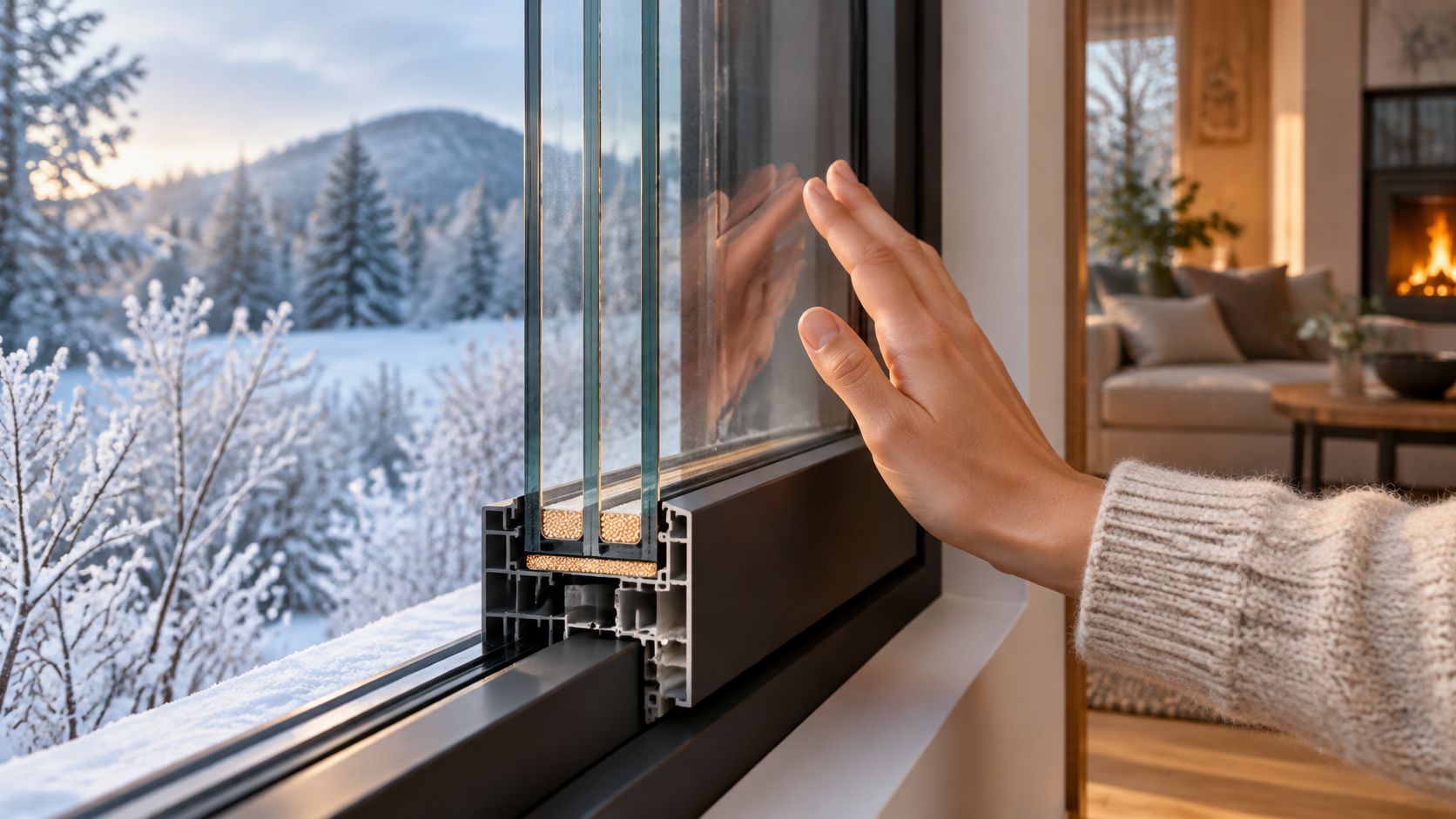
You're at a slim steel window on a cold morning, palm near the glass, trying to tell whether the pane is the coldest surface in the room or close to the wall. The quote in your other hand treats a third lite as the upgrade. It isn't. Pane count is never the spec. Climate, elevation, coatings, spacer, and whether the steel is broken decide if that extra sheet of glass earns its weight.
Table of Contents
- Why a Third Pane Is Not an Automatic Upgrade
- Double and Triple Glazing Performance Side by Side
- How a Triple Glazed Unit Stops Heat
- Noise Control Beyond Adding a Pane
- Where Triple Glazing Belongs by Climate and Facade
- Cost Weight and Carbon Before You Commit
- Specify the Steel Unit Before You Order
Why a Third Pane Is Not an Automatic Upgrade
Triple glazing windows earn their cost in heating-dominated and cold-mixed climates, on north, shaded, or noisy elevations, and only inside a thermally broken frame.
I would not price a third lite until that sentence is true for the opening in front of you. If the steel runs unbroken from outside to inside, you're buying glass the frame will short-circuit.
Sweden is the clean historical proof. After the 1973 oil crisis, building code SBN 75, implemented in 1976, capped window U-value at 2.0 W/m²K. Low-emissivity coatings of that time couldn't reach the limit alone, so triple-pane windows were standard in new Swedish buildings by the end of the 1970s, as a Lund University account of coated glazing in Sweden records. Germany took a related path: triple glazing was almost 60% of the glazing market in 2015, and thermally improved spacers were slightly more than 60% that same year.
For a U.S. project in 2026, the lesson is the same. Value sits in climate, code, frame, spacer, and whole-assembly performance, not in how many layers you stack. Heat-flow numbers, noise limits, carbon and weight, and the language on a custom order each have to clear that bar on their own.
Double and Triple Glazing Performance Side by Side
Read the rows before you fall in love with a center-of-glass quote. Lower U-factor means less heat flow. The best common insulating units use three glass layers, two or more low-e coatings, and inert gas.
| Measure | Double glazing reference | Triple glazing reference | How to use it |
|---|---|---|---|
| Best common glazing-unit U-factor | Ordinary doubles sit above this band | 0.3–0.5 W/m²K with two or more low-e coatings and inert gas | Lower means less heat flow; applies to the unit, not the installed window |
| Cited double-to-triple upgrade | About U-0.30 | About U-0.19 | About 60% or better improvement in the referenced rating system |
| Minneapolis whole-home energy | Typical double low-e baseline | Thin-triple about 16% lower | Heating-dominated; largest modeled saving |
| Washington, D.C. whole-home energy | Typical double low-e baseline | Thin-triple about 12% lower | Mixed climate; middle case |
| Houston whole-home energy | Typical double low-e baseline | Thin-triple about 7% lower | Cooling-dominated; smallest modeled saving |
How to read the unit rows
Lawrence Berkeley National Laboratory reports glazing-unit U-factors as low as 0.3–0.5 W/m²K for those three-layer, multi-coating, gas-filled units. The cited upgrade from double-pane to triple-pane moves from about U-0.30 to about U-0.19, a 60% or better improvement in that rating system. Those two rows describe the glass unit. They are not a promise for the window after the frame, the spacer, and the install are added.
How to read the city rows
The whole-home rows are climate context for thin-triple glazing versus typical double-pane low-e windows, not a guarantee for one opening. Heating-dominated Minneapolis shows the largest modeled cut in total residential energy use. Mixed-climate Washington, D.C. sits in the middle. Cooling-dominated Houston shows the smallest. Orientation, solar heat gain, frame conductivity, spacer design, air leakage, and installation quality move every one of those results.
A non-thermally-broken metal frame can erase much of the glass gain, because steel conducts heat around even a strong unit. On a custom steel opening, price the thermal break before you price the third pane. On an operable sash, the seal matters as much as the glass, so it pays to understand how outward-opening windows work before you treat a lab U-factor as the installed number. The build inside the unit is what produces these figures.
How a Triple Glazed Unit Stops Heat
Think of the unit as a thermos with two gaps instead of one. A single sealed cavity slows heat. A second sealed cavity adds another still layer, but only if gas, coatings, spacer, and frame all do their jobs.
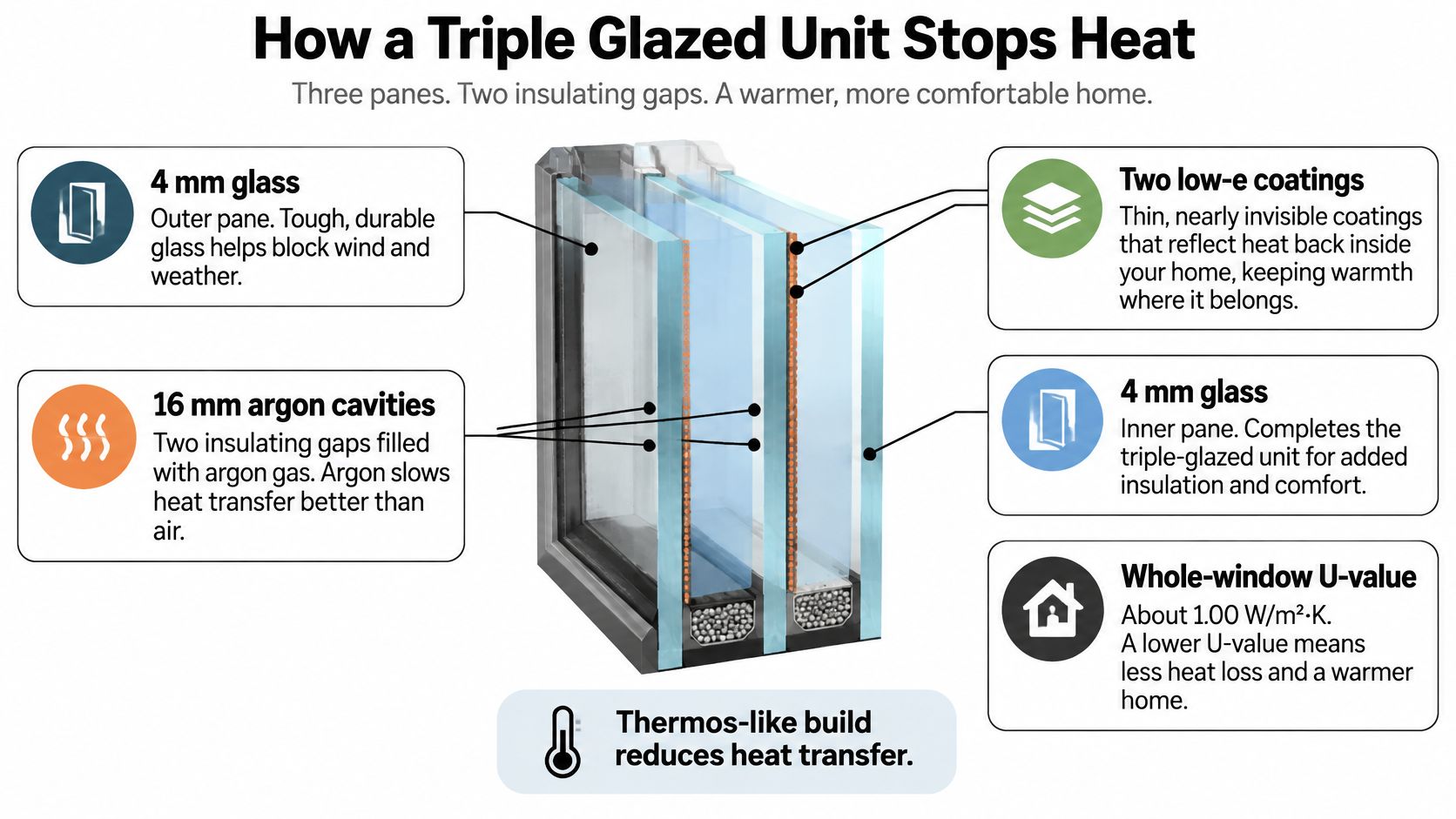
A representative build uses 4 mm glass, 16 mm argon cavities, and two low-e coatings. Your Home's glazing guidance puts that configuration at a whole-window U-value of about 1.00 W/m²·K, against about 3.0 W/m²·K for a basic double-glazed timber or uPVC window. The same triple example has an SHGC near 0.25 and visible transmittance near 0.36. Less conducted heat, less solar gain, and less daylight, in one picture.
The parts in order
- Outer low-e coating: It reflects room-side heat back inward in winter instead of letting the glass radiate it outdoors.
- Argon fill: The gas slows convection better than air, but only while the seal holds. A failed seal turns the cavity back toward ordinary air.
- Second cavity: The extra gap is another still layer between you and the weather, which is the actual point of the third pane.
- Warm-edge spacer: It cuts the cold line at the glass perimeter, where a metal box spacer would otherwise chill the edge.
- Frame: Steel conducts. An unbroken frame becomes a thermal bridge around excellent glass, and the installed window can lose much of the glass gain.
Center-of-glass numbers mislead for that last reason. For U.S. submittals, require NFRC-certified whole-window U-factor and SHGC, not a glass-only quote. A thermally broken frame is the piece that keeps interior and exterior metal from acting as one conductor. Coating choice by elevation belongs with placement, not with a single house-wide glass callout.
Noise Control Beyond Adding a Pane
A showroom line that calls triple glazing the acoustic upgrade is wrong. Pane count is a weak noise strategy. Thickness, cavity width, laminate, gaskets, and the install do more.
Canada's National Research Council, in a building digest on glazing and sound, finds that unless the gap between panes is very large, triple glazing can give the same overall noise reduction as double glazing. In one comparison, transmission loss was roughly 3 dB better below a mass-air-mass resonance near 250 Hz, and almost the same at higher frequencies. 3 dB is a just-noticeable change, not a quiet room.
What actually moves the rating
Controlled testing of 20 triple-glazed units found that thickening the outer glass by only 1 mm improved weighted sound reduction by more than 3 dB. Changing the middle pane by 1 mm did almost nothing. Spend the millimeter on the outer lite.
For traffic, airports, or nightlife, ask for a tested whole-window OITC, STC, or Rw. Prioritize unequal glass thickness, a laminated acoustic interlayer, larger cavity spacing, continuous gaskets, and an airtight install. Glass and frames that reduce noise are a useful cross-check when you're comparing laminate and frame sealing, not just pane count.
In slim steel, the operable sash, lock, and frame joints can leak sound a glass-center lab never measured. Require an assembly rating.
Write the quote as outer lite thickness, laminate type, cavity widths, and a whole-window acoustic test. Don't write "triple glazed for sound."
Where Triple Glazing Belongs by Climate and Facade
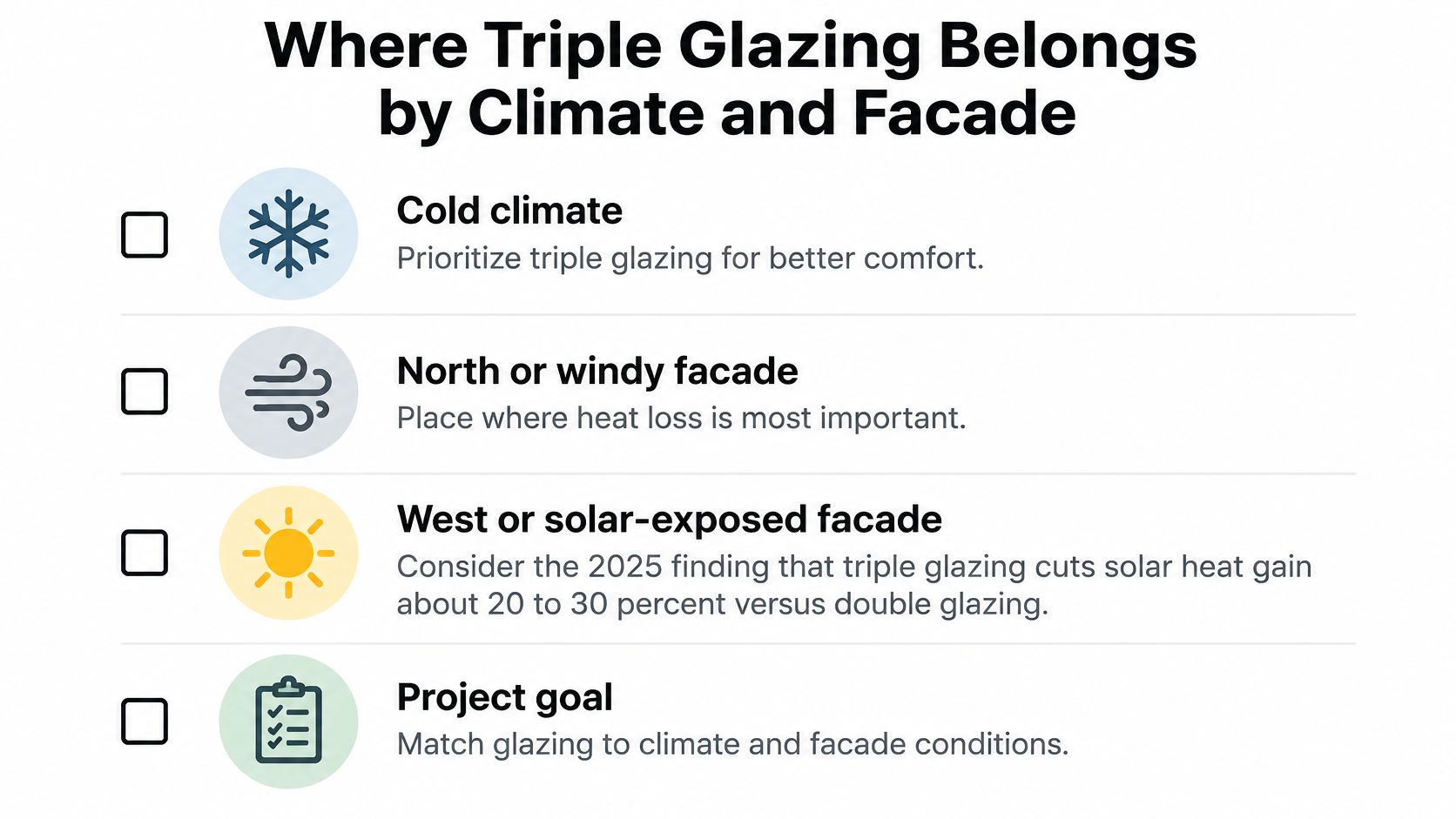
One spec for every opening is usually the wrong call. A 2025 study of glazing and solar gain found that triple glazing lowered solar heat gain by about 20–30% versus double glazing. That cut is the missed design question. The city pattern already tells you heating climates gain more whole-home energy reduction than cooling climates. Placement is how you use that pattern without cloning one unit around the house.
Four openings, four answers
North or heavily shaded wall, cold or mixed climate. This is the heat loser. It gets little winter sun, so a lower solar heat-gain coefficient doesn't rob you of free heat. Specify the lowest practical whole-window U-factor the frame can support, and accept a lower-gain coating.
South wall, cold climate. Winter sun is part of the heating system. A higher-gain double, or a solar-selective triple that still lets useful sun through, often beats a very dark low-gain triple. If the room overheats in March, fix shading before you kill the gain in the glass. Compare coatings in the glass options for windows you can order, elevation by elevation.
West wall, cooling climate. Late-day sun drives the cooling load. Low solar heat gain matters more than an extra pane, unless street noise or a strict energy code forces the third lite. Don't buy triple glazing here just to match the north elevation.
Street-facing bedroom. Energy savings can be modest and the acoustic package can still justify the construction. Unequal thickness and laminate, from the noise rules, belong on this opening even when the U-factor gap is small.
Cold-climate energy codes and passive-house targets push the choice through a whole-window U-factor, not taste. HVAC sizing has to follow the glass. Less solar gain can raise heating load on the south side while lowering cooling load on the west. Match coating and pane count to orientation, room use, and the frame break, and keep a high-quality double unit where winter sun is the point.
Cost Weight and Carbon Before You Commit
Energy saved is only half the ledger. Material spent is the other half.
| Factor | Triple vs double | Note |
|---|---|---|
| Glass | About 50% more | Green Building Advisor summary of one recent analysis |
| Spacers | About 100% more | Same analysis |
| Frame | About 30% more | Same analysis |
| Whole-home heating savings, thin-triple | About 12% average | Field and lab results vs clear double-pane |
| Whole-home cooling savings, thin-triple | About 27% average | Field and lab results vs clear double-pane |
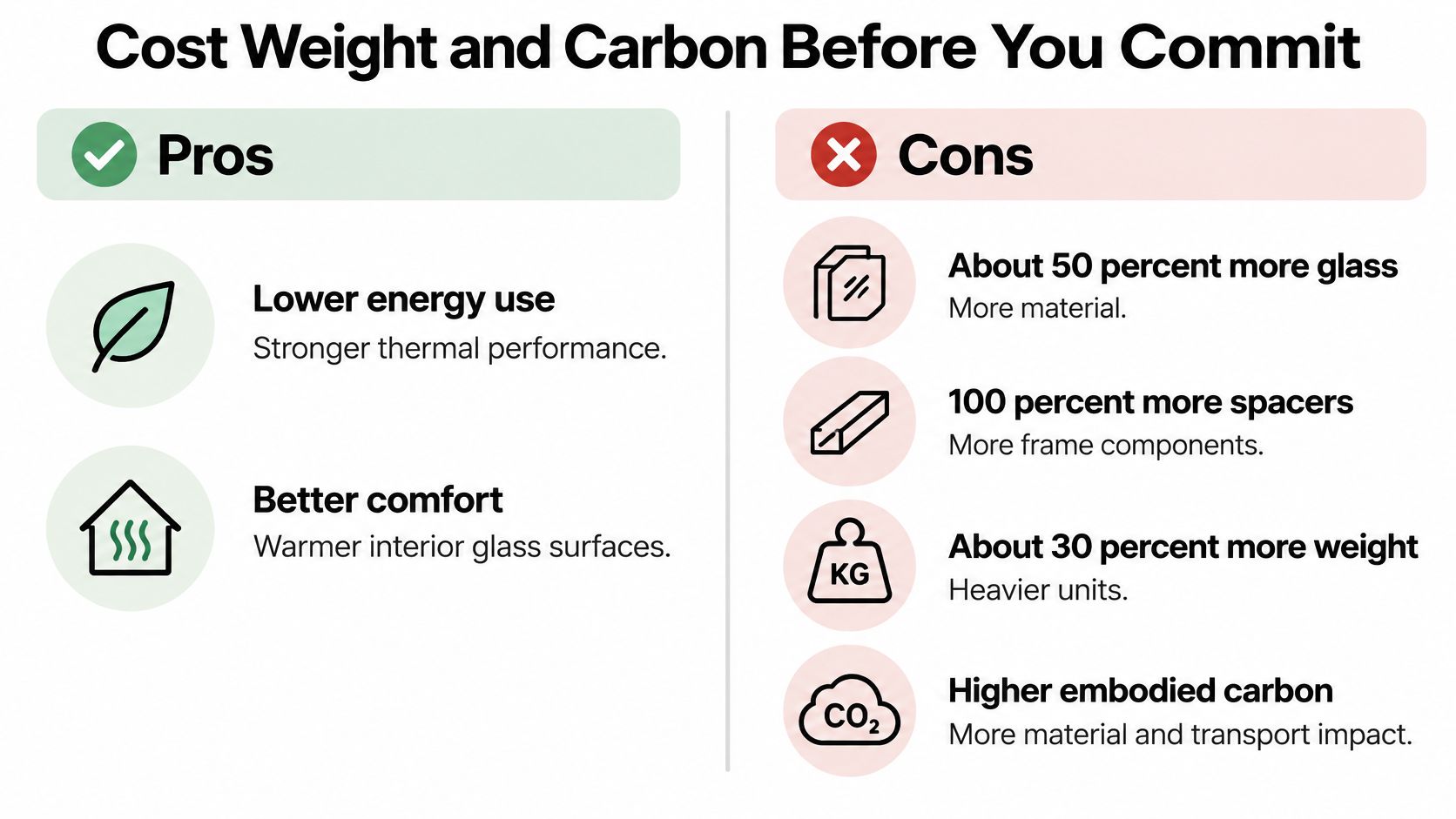
One recent analysis summarized by Green Building Advisor found about 50% more glass, 100% more spacers, and roughly 30% more frame than comparable double glazing, so the carbon crossover can take years or decades depending on climate and the grid, set beside field and laboratory validation of thin-triple windows. Those same results report average whole-home heating savings of about 12% and cooling savings of about 27% for thin-triple windows versus clear double-pane windows, with warmer interior glass and lower condensation potential.
Thin-triple is not a heavy triple
Thin-triple keeps weight closer to a double unit, which is why those savings figures are the fair comparison when the sash is already near its hardware limit. A conventional heavy triple loads hinges, stays, shipping, and the install crew on a large steel sash. The price has to cover more than glass: a deeper sash, stronger hardware, warm-edge spacers, argon fill, a longer lead time, and labor for a heavier unit.
Triple glazing reduces condensation. It doesn't remove it when indoor humidity is high, ventilation is poor, the spacer is cold, or the frame is a thermal bridge. If summer glare is what's left on a sunny wall you correctly kept as double glazing, light control with natural woven shades can tame that glare without another pane and without throwing away winter sun.
If a thermally broken double low-e assembly already meets the code U-factor and the elevation wants winter sun, spend the budget on the frame and the install. If the elevation is a heat loser, or the code miss is wide, price thin-triple first and heavy triple only when the sash can carry it.
Specify the Steel Unit Before You Order
Send the fabricator a list they can build, not a mood. Pane count is one line in that list.
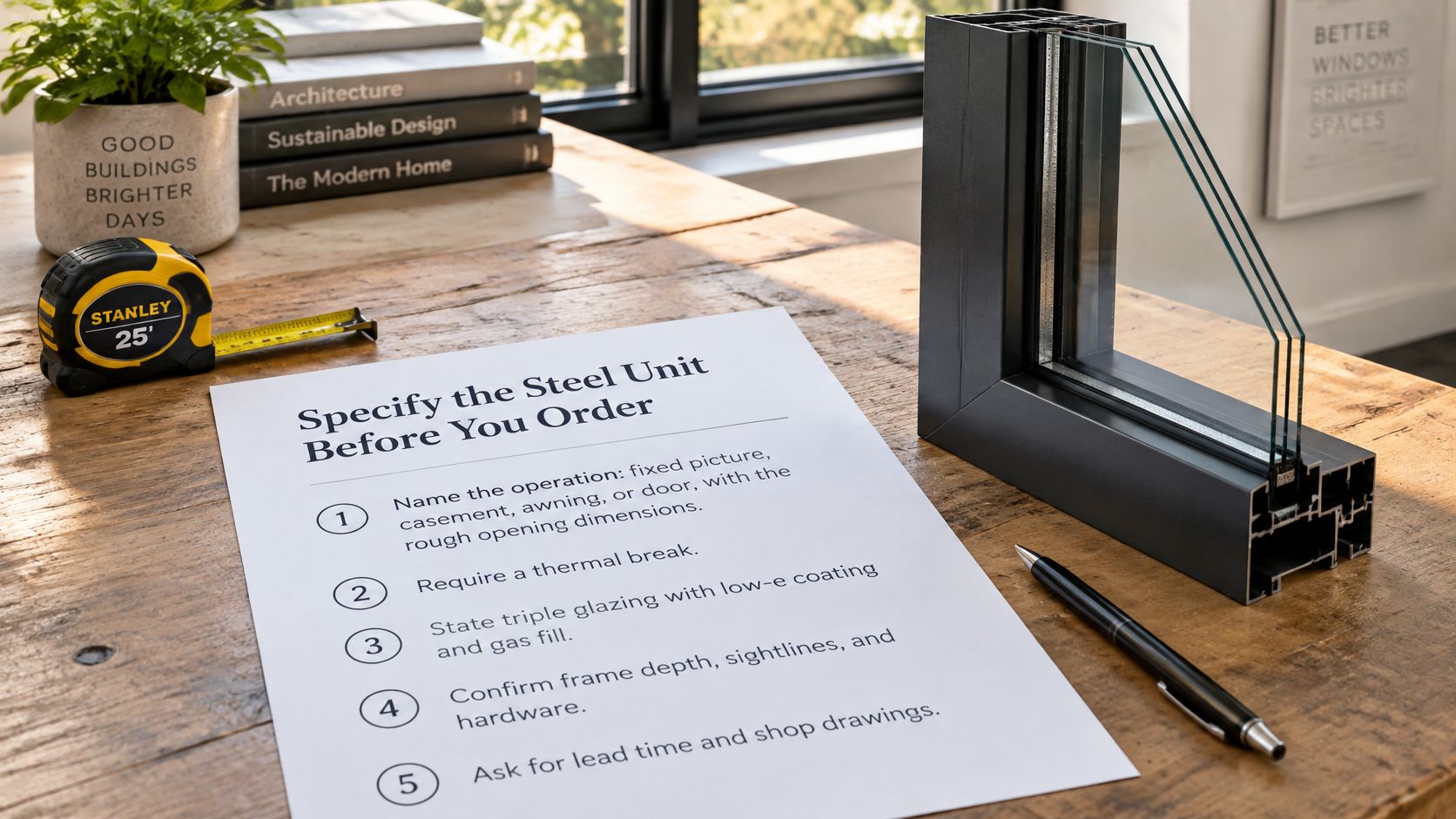
- Name the operation. Fixed picture, casement, awning, or door, with rough opening dimensions. A crank casement and a fixed lite don't share hardware or weight limits.
- Require a thermal break so interior and exterior metal are separated. Without it, the glass spec is decorative.
- Choose double or triple tempered glass by the facade rules already set. Call out argon fill and the coating's SHGC per elevation, not one coating for the whole house.
- Ask for NFRC whole-window U-factor and SHGC. Add OITC or STC if the street is loud. Reject a center-of-glass-only sheet.
- Confirm sash weight, hardware, and sightline still work with three lites. If the stay or hinge is at its limit, step back to thin-triple or to double.
- State the finish, and simulated or true divided lites only if the design needs them. Say the unit is made to order so nobody substitutes a stock sash.
Residential steel windows in a slim sightline only meet an energy target when that list is complete. We build custom steel and aluminum windows and doors for U.S. projects, and triple glazing is offered for extreme weather. Thermally broken windows and doors separate the interior and exterior frames to prevent heat or cold from transferring between them. A fixed square aluminum picture window with a thermal break and triple glazing starts from $279, and larger steel openings are quoted to the size you send.
Black Badge Doors makes factory-direct steel and aluminum windows and doors with slim sightlines, thermal breaks, and double or triple glazing for homes and commercial projects across the U.S. If your opening is custom, the climate is cold or mixed, and the steel has to hit an energy target without giving up the sightline, that is the unit to price. Visit Black Badge Doors to review configurations and request a consultation for the openings you're specifying.
Read more
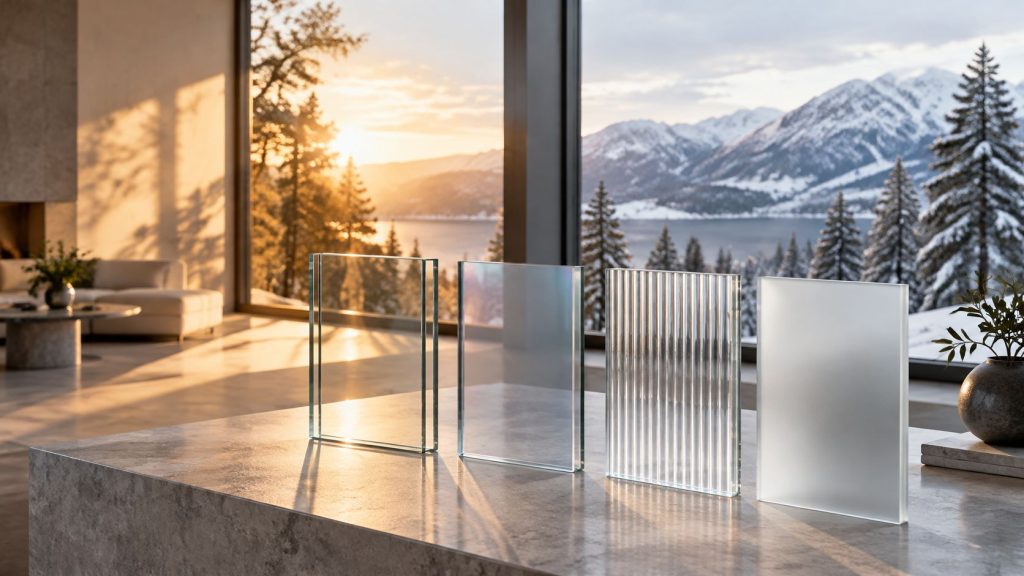
Glass Options for Windows by Climate and Use
A west-facing steel picture window can look flawless on the elevation drawing and still make a kitchen uncomfortable by late afternoon. A north-facing casement in the same house may get little direct sun and need...
Read more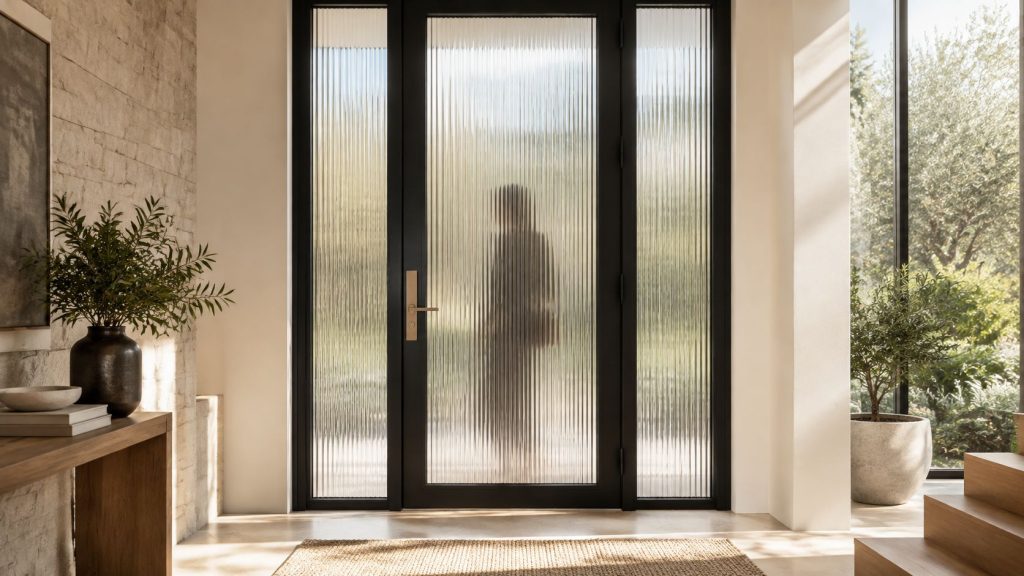
Ribbed Glass Doors: Privacy, Safety and Specifications
You're choosing a glass door to brighten a dark hallway, separate a home office, or give an entry some privacy. The fluted sample looks convincing in the showroom, but you're wondering whether someone standing outside...
Read more